


America's First Elected Black Governor Tells Activists, Politicians: 'Don't Stop. You Haven't Gotten There'
Former Virginia Gov. L. Douglas Wilder, America’s first elected Black governor, has encouraged an audience of civil and voting rights activists, community organizers and politicians to never stop fighting for the good of other people.
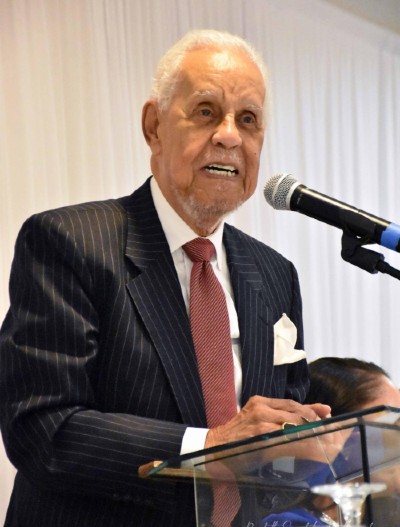 Former Gov. L. Douglas Wilder (Photo credit: Paulette Singleton/Trice Edney News Wire)“I am not a sheep waiting to be prodded by my shepherd. I am a lion and I refuse to [talk, to walk, to sleep] with the sheep. The slaughterhouse of failure is not my destiny. I will persist until I succeed,” Wilder drew from an inspirational quote he’d learned years ago as he closed his keynote speech to a standing ovation, cheers and applause by hundreds of people in the banquet hall of the Cedar Street Baptist Church of God in Richmond.
The occasion was the 70th Anniversary of the Richmond Crusade for Voters, an organization established in 1956, by three Black men for the purpose of pushing voter registration amidst racist resistance to Black political progress. The audience was wowed as Wilder, a 95-year-old grandson of slaves, spoke candidly from his heart, imparting wisdom to them with no notes and no glasses.
“So, what am I telling you? You don’t stop. You haven’t gotten there. And you’re not going to get there unless you [persist],” he said.
Wilder, whose remarks stressed several key moments in Virginia history, has always espoused the principle of learning from the past while moving forward. In doing so, in 1969, he was elected as the first Black member of the Virginia Senate since Reconstruction and became America’s first elected Black governor in 1989 after serving four years as lieutenant governor. He is now still working as a distinguished professor at the Virginia Commonwealth University L. Douglas Wilder School of Government and Public Affairs.
“You don’t live in the past. You learn from the past,” he said, listing some of his accomplishments during his years in elected office.
As a senator, he recalled speaking publicly against and even protesting the song, “Carry Me Back to Old Virginny” as the Commonwealth’s state song because of its racist lyrics that included, “There’s where the old darkey’s heart am long’d to go.”
Wilder continued, “The second stanza was even worse” as the song described, “Even in death after they’ve gone to heaven, wherever they both would be going, they wanted to be reunited with ol’ massa.’”
As a young senator, Wilder called for the “getting rid of it. And we did.” Because of his protests, the Virginia Legislature stopped singing the song the same year that he was first elected.
He also pointed to Virginia’s Martin Luther King (MLK) holiday as largely the result of his persistence and hard work. Govs. Mills Godwin and John Dalton consecutively vetoed the MLK holiday bills in 1977 and 1981.
“MLK Day took me eight years,” Wilder said. “People take for granted the Martin Luther King Day. It didn’t just happen. We fought for it and finally got it.”
Wilder noted that when the MLK bill ultimately passed in 1984, making Virginia the first state in the South to celebrate an MLK holiday, there were few African-Americans in the entire General Assembly, therefore, a majority of White members had to vote for the bill for it to pass. This fact underscored Wilder’s ability to appeal to people – not based on their race or political affiliation; but based on their humanity.
For anyone who said that Doug Wilder “will reach across the aisle,” he corrected, “that wasn’t quite right…I didn’t recognize any aisle. I didn’t see an aisle to reach across. I saw a senator. I saw a delegate. I saw a person. And that’s the way I lived. And I will continue so to live.”
Politicians and candidates in the room, from various seats across the Commonwealth, listened intently as he spoke, many likely recalling some of the fights they too encountered in Virginia history.
U. S. Rep. Bobby Scott of Norfolk, who served as Virginia delegate and senator for 13 years before he was elected to the U.S. Congress 33 years ago, lauded the Crusade as being “more important now than ever before.”
That importance is not only because of the organization’s success in helping to quadruple the numbers of Blacks in elected office but, there were even few Black judges until the Crusade started “slowly but surely making Democracy work,” Scott said.
The founding of the Crusade was led by the late Dr. William S. Thornton, a podiatrist, Dr. William Ferguson Reid, a surgeon; and the late John M. Brooks, an NAACP voter registration organizer. It was established to strengthen Black voting and to oppose Virginia’s massive resistance to desegregation in response to the Brown v. Board of Education Supreme Court decision.
But the importance of the Crusade for Voters and other similar organizations around the country is also because of the work that remains ahead, Scott said.
“And so, we’ve got to get back to the old days. Make sure people are registered. Make sure they come out to vote and make Democracy work in our favor,” Scott said. “We need to get back to those basics…The only way to protect your right to vote is to exercise your right to vote. Use it or lose it,” he said, reflecting on recent Supreme Court decisions that effectively gutted protections under the Voting Rights Act.
Chuck Richardson, who was a member of Richmond’s first majority Black City Council, elected in 1976, said the Crusade’s 70th anniversary celebration was significant because "our history must be institutionalized so that we remember and honor those who made a contribution."
Wilder said in his speech that Richardson, in his early years on Council, would often seek his advice, "and he listened.”
In an interview after the dinner, Richardson, who never lost a City Council election in his 19 years of service, said that was largely “because of Doug Wilder’s wise advice to me. Also, the Crusade had a disciplined voting electorate that followed the advice of the Crusade. And Wilder would tell them that once we made an endorsement, there would be “’no breaking of the ranks.’”
That didn’t mean that the politicians and the Crusade always agreed, Wilder pointed out. The Crusade leadership even chided him when he initially fought against the state song because they argued that there were more important issues, Wilder said. “So, I caught a bit of flack for that in terms of getting that done.”
But he continued to rise. Ultimately, under Wilder’s gubernatorial administration, Virginia was named the best-managed state in the nation by Financial World magazine – for two years in a row – in part, for his balancing of the budget without raising taxes.
Virginia State Senator L. Louise Lucas (D–Portsmouth), a Black woman, currently serves as the chair of the Senate Finance and Appropriations Committee in the Virginia General Assembly. When Wilder acknowledged her in the audience, she confirmed that she too seeks his advice.
But the common vision for what was fair and justice for all people was what brought about the successes. “I understood that things could be better,” Wilder said. “I want nothing but what’s good for the people. There’s so many things that you can do. Don’t stop.”
Though Wilder’s message encouraged the Crusade to continue and even increase its mission, with mostly seasoned public servants in the sold-out room, there appeared to be a glaring absence of younger people and students to deal with future issues. In closing remarks, Banquet Chairman Richard Williams, organizer of the lively event hosted by CBS 6 Anchor GeNienne Samuels, said he met Wilder when he was just a third-year student at the University of Virginia, interviewing him for a term paper for Professor Larry Sabato, a nationally renowned political scientist. But that was in the 1970s when Wilder was in the Senate. Williams drew chuckles from the audience when he told how he got lost looking for Wilder’s office because there was “no Map Quest or Internet.”
The room was full of energy and joy as a spirited Wilder imparted humor and wisdom to enthusiastic applause and laughter before receiving the President’s Award from Crusade President Bryce Robertson.
Despite the age gap in the audience, Robertson, who appeared to be in his 20s, exuded the wisdom of the Crusade founders: “Every voice has value, every citizen has a role to play, and an organized community has the power to shape its own future,” he said.
“Democracy still depends upon people willing to participate, and meaningful change begins when people recognize the power they possess when they act together.”

