


BELMOPAN, Belize – The Belize Department of Civil Aviation (BDCA) has launched a technical assistance project to develop a Concept of Operations (CONOPS) for the country’s inter-airport system capacity and route efficiency.
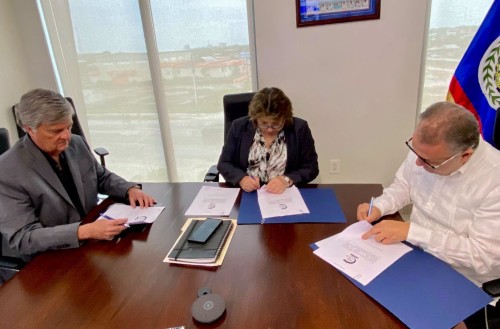 Tetra Tech, an international aviation and engineering consulting firm sign agreement for airport projectThe work is being carried out by Tetra Tech, an international aviation and engineering consulting firm, and is expected to take approximately six months.
The study will examine how aircraft move through Belize’s airports and airspace and will then recommend practical ways to handle more flights safely and with fewer delays. The goal is to get the most out of existing runways, routes and air traffic systems before the country commits to major new infrastructure spending.
The project covers the Philip S. W. Goldson International Airport (PGIA)and domestic airports with scheduled service, including San Pedro, Caye Caulker, Placencia, Dangriga, Corozal and the Belize City Sir Barry Bowen Municipal Airstrip.
The authorities said that particular attention will go to the busy PGIA–San Pedro corridor. International links to the United States, Canada, Mexico and Central America are also in scope.
“This CONOPS is a first of its kind for Belize. It is intended not just to bring order to airspace management for a thriving aviation sector, but also to prepare us for a possible doubling of air traffic by 2045 as projected by the International Air Transport Association (IATA),” said Nigel Carter, the Director of Civil Aviation.
The BDCA said that the project will be undertaken in four phases, with the first being a three-day on-site visit to Belize, including a meeting at BDCA offices, interviews with stakeholders, and visits to air traffic control facilities and selected airports.
The second phase will allow for an analysis of the current and future traffic demand, delays, peak-hour operations, air navigation technology and procedures, compared against International Civil Aviation Organization (ICAO) standards with the third phase being a plan focused on efficient route use, demand management, coordination among stakeholders and safety, prioritizing improvements that need little capital investment.
The fourth phase will be a final CONOPS with recommendations, alternatives and a prioritized implementation roadmap, presented in person to the BDCA and stakeholders.
The BDCA said it will work closely with the Central American Corporation for Air Navigation Services (COCESNA), airlines, airport operators and other stakeholders throughout the project.
“The study will not affect flight schedules or airport operations. Travelers and the public should notice no disruption while the work is under way,” it added.

