


BRIDGETOWN, Barbados – The Bridgetown Summit on AI Safety got underway here on Monday with United Nations Secretary General, Antonio Guterres, warning that the risks of unchecked digital technology are growing and that the ability of countries to manage these risks remains deeply unequal.
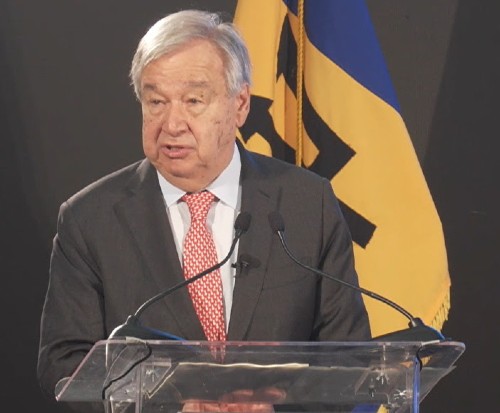 Un Secretary General Antonio Guterres addressing the opening of the Brdgetown Summit on AI Safety in Barbados (CMC Photo)The one-day conference co-hosted by the Barbados government of Barbados and the United Nations, has brought to together virtually and in person, leaders and stakeholders to advance international cooperation on artificial intelligence (AI) safety.
Guterres told the opening ceremony that global challenges require global solutions and that the countries most exposed should not simply adapt to decisions made elsewhere.
“They must have a voice in shaping them. That principle is vital for artificial intelligence. The promise is real. AI can strengthen health systems. Accelerate scientific discovery. Transform education. Improve weather forecasts. And advance sustainable development. AI systems are becoming more capable and more widely deployed.
“But the risks of unchecked digital technology are growing just as fast , as we have seen in recent days with the wave of technological outages and cyberattacks. And as we have heard in recent months from some of the pioneers and creators of artificial intelligence who have raised the alarm about its potential existential risks.”
Guterres said that when those developing the technology themselves say that the risks could be profound,” the world has a responsibility to take those warnings seriously.
“The dangers are clear. Technology without accountability. Capability without safeguards. And power without responsibility. The ability of countries to manage these risks remains deeply unequal.
“We cannot allow AI to replicate, and deepen global inequalities. Solutions must be as borderless as the risks we face,” he said, adding that this summit can help strengthen national approaches, without expecting a single model to fit every country.
He said that means building a shared understanding of emerging risks as well as greater interoperability through comparable evaluations, common terminology and shared learning from serious incidents.
He said it also means strengthening every country’s capacity to test whether AI systems work safely in local contexts.
Guterres told the opening ceremony that the UN-supported Global Network for Exchange and Cooperation on AI Capacity Building already has 27 centres of excellence across five regions and that he has proposed a Global Fund for AI Capacity-Building.
“Throughout, our approach must be grounded in independent science, as provided by the Independent International Scientific Panel on AI,” Guterres said, adding that its first report shows that AI guardrails are trailing capabilities.
“Wider deployment requires stronger safeguards. Safety must travel with the technology. The Panel’s new thematic brief on AI capacity building, released yesterday, shows that progress can be made. It demonstrates how countries are closing gaps in capacity to govern digital technology — in particular evaluation capacity, to ensure systems are safe across languages and cultures. But far more needs to be done to manage the risks of AI.”
Guterres said that is why he has called for a multilateral framework for AI risk management backed by credible and independent oversight.
“The world cannot afford a race to the bottom on AI safety. Momentum is growing. From the first Global Dialogue on AI Governance in July, to give every country a seat at the table… To the Call for Control of Frontier AI Models launched by Finland and Norway… To the Paris Call for AI Safety and Security.
“Bridgetown is our next step to ensure AI systems are safe and trustworthy — wherever they are developed and deployed. This technology and its governance must work for all countries. Ladies and gentlemen, Let’s ensure that artificial intelligence is shaped by humanity, with humanity, and for all humanity,” he added.

