


CASTRIES, St. Lucia – Caribbean Community (CARICOM) leaders have been told that the 15-member regional integration movement is no longer optional, idealistic or solely resident in reports and commissions, but it is existential.
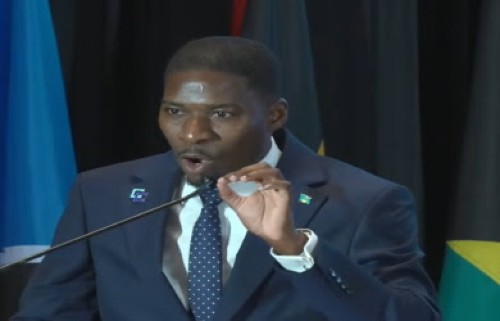 Rahym R. Augustin-Joseph, addressing the opening of the 51st CARICOM summit on Sunday night (CMC Photo)“And if ever there was a time for us to integrate, it is now,” Rahym R. Augustin-Joseph, a St. Lucian scholar, policy advocate and public commentator told the opening ceremony of the CARICOM summit here on Sunday night.
The Commonwealth Caribbean Rhodes scholar said he fears that he fears, that in this moment, notwithstanding all of the region’s successes, “we remain stuck in our crease, trapped by the nostalgia of runs scored in the past, when we should be dancing down the wicket, playing with the turn, finding gaps, and scoring runs.
“Instead, I worry that the politics of integration is not meeting the energy, the ambition, and vibrancy of the young people, and ordinary citizens who are already every day, writing the pages of Caribbean integration,” he said in his feature address to the 51st CARICOM summit.
Augustin-Joseph said the tragedy is not that the Caribbean people lack a regional imagination, but that the tragedy is that their imagination is often moving faster than regional institutions. “The question is whether you their leaders are prepared to match their ambition by rising to this occasion. But you may ask, what is this vibrancy, this ambition, that the politics of integration is not meeting?
“Heads, every day, a young man in this region may be struggling to find employment in his own country, but is unable to unlock the regional market of opportunity and vacancies, because it is frustratingly shrouded with duplicitous and burdensome processes in the Skills Certificate Administration.
“His talents are Caribbean, but his potential contributions are constrained by small island mindset and small island structural barriers. He is hampered by regional transportation woes, can’t even seamlessly spend a season abroad unless unfortunately he has to be relocated because of a disaster, or he is aware of how some for advantage have fanned the flame of fear towards those who have not come from our countries.”
Augustin-Joseph, who graduated from the University of the West Indies (UWI) with a First Class Honours in Law, and is now pursuing a Masters Degree in Public Policy at the University of Oxford’s Blanatnik School of Government, said that the people of this region, are not naïve of the changing world.
“And we know that CARICOM is affected by the global polycrisis. And whether it be a feeble and fleeting international rules-based order…which was not created for us, but, which provided us with certainty, and predictability, while we proverbially turned the other cheek, as within its design, was always a shifting goal post by those who invented the system, on sketchy evidence and impervious positions.
“From bananas to financial services, to off-shore financing, to anti-money laundering, to reparations, citizenship by investment, blacklisting, I could go on and on, but the full story has never been told.
“In this changing world, we see a biting bluntness, where the ‘superpowers’ attempt to reassert civilisation hierarchies, with the lingo of ‘first’ ‘only’, ‘capture’ and where the middle powers turn blind eyes, accommodating, deferring, only, until they too are threatened.
“And whether it be the anti-immigration policies, where our godfathers and aunties are being called ‘others’ and deported from lands they have helped build, because ‘opportunity are scarce commodity’, at home, or Wars in the East and West which causes rising cost of living and reduce your fiscal space. “
Augustin-Joseph said the Trinidad-based Caribbean Court of Justice (CCJ) had reminded the region 13 years ago, in the seminal case of Shanique Myrie v. the State of Barbados, that, the Caribbean citizen has a right to enter and be permitted to move freely in another Caribbean territory, without any form of harassment, impediment, and they must feel a sense of belonging.
“But, our journey remains incomplete, as the accession to the CCJ, in its appellate jurisdiction, should be put back on the proverbial ‘kitchen table’ in Grand Anse, or Siparia, Kingston, St. Paul or even Kingstown, and there must be a regional galvanising of support for the referendum.
“We should be singing with one accession tune, galvanising public sentiments and support, in much the same way as we have done locally, and reconsider our national ambitions of concurrent courts, not utilise our disagreements with the court to stand in the way of justice, and reject this false binary of getting the economy right first before we deal with questions of justice, as if we are single issue countries that cannot walk and chew gum.”
He said that at a time when some governments tell their people to look inward, and their immigration policies tell Caribbean people that they are outsiders, “we should be looking inward for a different reason: to strengthen our own institutions and deepen confidence in ourselves.
“The CCJ must therefore be the final court of appeal for all of our countries in this region! It is because we have not been doomed forever to be at somebody else’s mercy, that this CARICOM has created a University of the West Indies, which for decades have been educating Caribbean minds, contributing towards Caribbean thought and leadership, and filling every office in this region with graduates that lift their families from poverty.”
Augustin-Joseph said the region has done well in this changing world, “to ensure that the world appreciates, our unique circumstances and commits to making progress on reducing greenhouse gas emissions, recreating the global financial ecosystem, reducing blacklisting and onerous financial compliance requirements and ultimately providing reparatory justice for the horrors of enslavement and genocide”.
He said that St. Lucia presents an ideal opportunity for CARICOM to re-establish itself and to move from resilience to renewal “because our island is inextricably bonded with Caribbean integration, by producing people and ideas that have continually renewed the Caribbean project.
“Sir Arthur Lewis, a child of integration and one of its greatest architects, dedicated his life to understanding and resolving the Caribbean problematique. From Labour in the West Indies, to his unrelenting case for federation to his pioneering leadership of regional institutions. And Sir Derek Walcott taught us that the Caribbean need not remain a subject of someone else’s story”.
Augustin-Joseph told the regional leaders that as they deliberate over the coming days, he is asking them “to give serious consideration and make meaningful progress” on five “nagging issues facing our union”.
He named them as the implementation deficit disorder, freedom of movement of people, deepening the partnership with Canada and the African Continent respectively as well as finally treating food security as national security and regional security.
He said also that the region must not allow Artificial Intelligence to become another Industrial Revolution that happens to the Caribbean, rather than with the Caribbean.
“Artificial Intelligence will reshape how we learn, work, govern, deliver justice, diagnose illness, educate our children, and compete in the global economy. If we do not prepare together, we will once again become consumers of technologies designed elsewhere, instead of creators, regulators and innovators in our own right.
“Let us therefore develop a Caribbean strategy on Artificial Intelligence that invests in digital skills, safeguards our people, protects our data, supports Caribbean entrepreneurship, and ensures that technology serves humanity, not the other way around.”
He acknowledged that while the list “is not exhaustive” having not made mention of the situation in Cuba and Haiti “what this list must never do, is cause us to be divorced, from the principles that have built and sustained CARICOM.
“Our principles must be the seasoning that is embedded in all of our conversations and decisions,” he said, recalling the principles such as the Barbadian foreign policy position, by then prime minister Errol Barrow, that the region would be “friends of all countries and satellites of none”.
Augustin-Joseph said that the region has traded the revered maturity and civility of regional politics, for mimicry of 280 characters, akin to filmed episodes on a regional reality tv show. “And what is worse is that the children and young people of this region are watching, wondering what episode of Love Island they must be watching. We have traded arguing about ideas to move us forward, for, agonising about everything that is allegedly wrong.
“We have traded our strength that comes from speaking with one unified voice, for divergent positions that feed insularity, and allowing for divide and conquer. At times, we have found ourselves too willing to accommodate those who neither share our principles nor consistently uphold the international norms they ask us to defend, ignoring that we are at our best when our functional cooperation works and is not utilised as phraseology to justify the discretion of having individual contrasting positions.
“But St. Lucia is a place where you can recommit to our principles, and to put what should be an aberration, a genuine lapse of judgement behind us,” Augustin-Joseph added.

