


PANAMA CITY, Panama – The Secretary General of the Organization of American States (OAS), Albert Ramdin, Tuesday underscored the important role played by the permanent observers in the hemispheric body meeting its obligations.
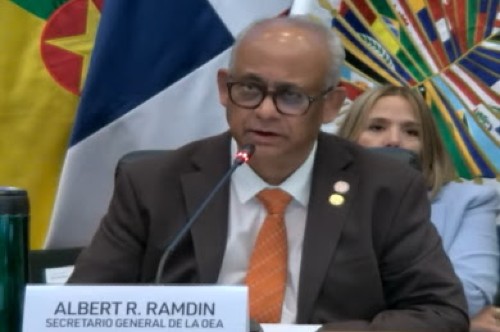 Ramdin told delegates attending the 56th OAS General Assembly that the work of the OAS is necessary in order to address the growing challenges in the Western Hemisphere and that multilateralism and solidarity are essential for the preservation of democracy, security, and economic development.
Speaking on the theme multilateralism in the events of democracy, hemispheric security, and stability in the member states, Ramdin said it was chosen by the host government, Panama as “a serious aspiration, but equally an immediate requirement of our time.
“It speaks to the concerns of our region and to those of nations around the world. There is no better place to take up this discussion than here with the member states and the observers from around the world gathered here today.
“In that same spirit, we deeply appreciate the active role that many observer states play in advancing the very theme of this year’s assembly. It is largely thanks to our permanent observers that the Organization of American States can continue to strengthen the promotion and defence of democracy through electoral observation missions, support peace-building efforts, and reinforce the work of the Inter-American Human Rights Commission.”
Ramdin said that it is also at the center of advancing the hemispheric body’s multidimensional security and sustainable development programmes in many countries and many regions.
“These partnerships, ladies and gentlemen with observer states, help demonstrate the value of the OAS in supporting the countries and the peoples of the Americas,” said the former Surinamese foreign affairs minister, noting that since taking office a year ago, he has made it a clear priority to deepen and widen the OAS’s engagement with permanent observer states.
“I am deeply grateful for the meetings I have held with heads of state and other high-level authorities, both at headquarters and in your capitals. We have begun this effort with those observers that maintain dedicated missions to the Organization – Spain, Italy, France, and the Holy See.
“Building on this foundation, we have launched more structured and forward-looking programmes of cooperation and exchange, and we sincerely thank you for the trust you have placed in us.”
Ramdin said last year, the OAS reached a historic milestone, receiving a record of US26.3 million in contributions from all members of the permanent observers, and directed to OAS programmes across the four pillars of the Organisation.
He said he would like to particularly highlight the recent contribution of Euro10 million (One Euro=US$1.29 cents) from the European Union to support the OAS programme for the construction and equipping of forward operating bases in Haiti’s West Department.
“Looking ahead, we remain committed to building multi-year partnerships, frameworks with our permanent observers, aligned with the Organization’s institutional priorities. These frameworks are essential to promoting greater predictability, sustainability, and long-term impact for OAS initiatives.”
But he said at the same time, the OAS is conducting high-level political dialogues with strategic partners to assess the state of the existing cooperation and establish roadmaps for collaboration in the medium term.
“So, no programmes for one year alone, but multi-year programmes. Most recently, I held dialogues with the European Union and Spain, during which we had productive exchanges on our existing cooperation and agreed on a roadmap structure to further strengthen our partnerships in the years ahead.
“We are advancing the same model with key partners, including Spain, Italy, and Morocco, and we look forward to deepening our collaboration with permanent observers from every region of the world.”
Ramdin also highlighted the 20th anniversary of the Spanish fund to the OAS, which he described as a “landmark mechanism” that has facilitated Spain’s cooperation and that serves as a blueprint for permanent observers to work with the OAS.
In his address, Ramdin said that the Americas face a convergence of challenges that transcend borders. He said from persistent inequality and democratic fragility, to insecurity, irregular migration and climate-related disasters, no country can effectively respond in isolation.
“These are shared challenges that require shared solutions in our work,” he said, noting that Haiti has been at the centre of these challenges.
“Addressing the country’s ongoing security, humanitarian, and institutional challenges require sustained international solidarity and coordinated action. Supporting Haiti’s path towards stability, democratic governance, and recovery is essential not only for the well-being of its people, but also for the peace and stability of the wider region.”
Ramdin said he wants to especially thank the observer countries that have supported the Haiti roadmap towards peace and stability, namely the European Union, Spain, Japan, Serbia, Korea, and Ukraine.
“…we look forward to others joining us in these efforts. So for us, it’s important that we seize this opportunity to continue strengthening our shared commitment to cooperation, dialogue, and multilateral action.
“Together, we can continue building a hemisphere that is more democratic, more secure, better prepared to respond to the aspirations and needs of our people,” Ramdin added.

