


GEORGETOWN, Guyana – Guyana remains on course to help the Caribbean Community (CARICOM) achieve its target of reducing the region’s food import bill by 25 per cent by 2030, Agriculture Minister Zulfikar Mustapha said Tuesday.
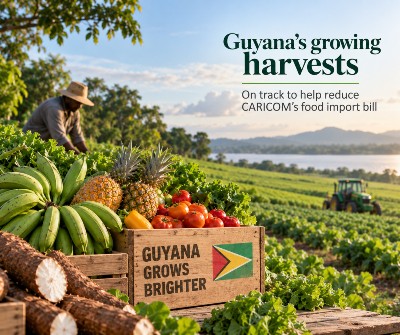 Mustapha said Guyana’s progress in expanding agricultural production is contributing to regional food security and efforts to reduce the Caribbean’s dependence on imported food.
He was speaking in an interview with the Department of Public Information (DPI).
The minister said the regional target was established following a CARICOM Heads of Government meeting in Belize, where President Dr Mohamed Irfaan Ali outlined a strategy to reduce the region’s food import bill.
“Guyana has emerged as the leading CARICOM in advancing the agri-food system and, at the same time, a leading voice in prioritising food security,” Mustapha said.
He said CARICOM has since adopted the strategy, with member states working collectively towards the 25 per cent reduction target by 2030.
Mustapha said Guyana recorded significant progress when the target was assessed in 2025, achieving what he described as a 77 per cent success rate.
He attributed the progress to increased agricultural production, greater investment in the sector and collaboration among CARICOM member states.
“Many countries in the Caribbean, CARICOM, now are requiring our strategy, our help, our expertise,” Mustapha said, adding that Guyana is also providing technical support to countries seeking to expand their agricultural sectors.
The minister acknowledged that several Caribbean countries have experienced setbacks due to hurricanes and other natural disasters, which affected agricultural production and slowed progress towards the regional target.
He nevertheless expressed optimism that the 25 per cent reduction target can be achieved by 2030, particularly as more countries expand their productive and agricultural sectors.
Guyana’s domestic production across 15 CARICOM priority commodities increased from 1.41 million tonnes in 2020 to 1.81 million tonnes in 2025, an increase of 394,698 tonnes, or 27.9 per cent.
The country recorded significant gains in emerging areas, including corn and coconut production, while also expanding soybean production to support the animal feed industry.
Livestock production increased by 12.5 per cent between 2020 and 2025. Poultry production rose by 11.5 per cent, beef by 11.7 per cent, pork by six per cent and eggs by 12.4 per cent.
Mustapha said Guyana is also seeking to increase onion production, with approximately 300 acres expected to be cultivated in Region Nine during the current crop.
He said the expansion is intended not only to meet domestic demand but eventually to position Guyana as a net exporter of agricultural commodities to the Caribbean.
“We are not only doing agro-processing to sell locally,” the minister said. “Our agro-processing products are being sold in different parts of the Caribbean.”
Guyana’s increased agricultural production is expected to support its food security objectives while contributing to CARICOM’s efforts to reduce the region’s food import bill by 25 per cent by 2030.

