


UNITED NATIONS – Antigua and Barbuda Prime Minister Gaston Browne has called for the urgent operationalisation of the Multidimensional Vulnerability Index (MVI), warning of the current threats facing small island developing states (SIDS).
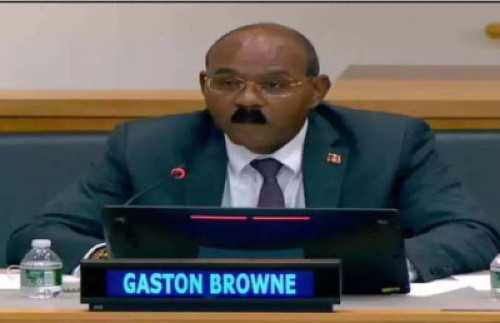 Browne, the co-chair of the United Nations Secretary General’s High-Level Panel on the MVI, said that SIDS now have a tool that more accurately reflects their realities as venerable states. He said gross domestic product (GDP) measurements failed to account for the unique vulnerabilities facing small states. As a result, many islands continue to face significant challenges in accessing critical development financing, particularly in times of crisis and disaster when it is needed most.
Addressing the High-Level Retreat on operationalising the MVI, Prime Minister Browne said that while the world has changed dramatically in recent years, the rules governing access to development finance have not.
The MVI was adopted by the United Nations in 2024, but has yet to be operationalised within the global financial architecture.
The event here was co-organised by Antigua and Barbuda, Portugal and the United Nations Office of the High Representative for the Least Developed Countries, Landlocked Developing Countries and Small Island Developing States (UN-OHRLLS), and the United Nations Department of Economic and Social Affairs (UN-DESA).
It was convened against a backdrop of growing global uncertainty and vulnerability with the organisers noting that the current context presents a timely opportunity to reinvigorate the global vulnerability discourse and showcase arly efforts at implementing the MVI.
The event was designed to serve as a strategic bridge between high-level intergovernmental mandates and practical implementation, helping to catalyze the next phase of the MVI’s evolution.
Prime Minister Browne noted that nine Caribbean countries generate more than 80 per cent of their electricity from imported fossil fuels, while five others import more than 90 per cent of their energy.
“Electricity consumers across our sub-region pay some of the highest tariffs in the world, frequently approaching twice the average of developed countries. This is not because we are inefficient, but because we are trapped.’
Browne said that island states are held captive by an energy model “built on imported petroleum, designed for larger economies with greater market leverage, and maintained at enormous cost to our public finances, our competitiveness, and our people.
“When global oil prices spike, as they did after COVID, as they did after the war in Ukraine and as we see currently with the war in Iran, our vulnerable countries absorb the full shock. We simply have no buffers.”
He said that renewable energy is a realistic option, but the pathway to securing the concessional financing needed to build the necessary infrastructure remains out of reach because of the very barriers the MVI seeks to address.
“Here is the injustice. Because we are classified as middle-income countries based on GDP per capita, we are routinely denied the concessional access that our actual vulnerability demands.
A country like Antigua and Barbuda, one of the smallest in the world and with a GDP per capita above an arbitrary threshold, is told it does not qualify,” Prime Minister Browne said, reaffirming his commitment to championing the MVI as the leader of a country that has lived the consequences of a system that does not fully recognize its realities.
“We have rebuilt after hurricanes using borrowed money at commercial rates, while larger, wealthier nations accessed the same capital at a fraction of the cost. We have paid some of the highest energy prices on earth because we could not access the financing needed to build the solar capacity that would free us from that dependence.
“We have been told we are too prosperous to qualify for support, even as we were told in the same breath that our debt was unsustainable and our infrastructure inadequate,” said Browne, urging the delegates to intensify heir advocacy and push for the operationalisation of the MVI.
He further encouraged them to make full use of the MVI’s Vulnerability and Resilience Country Profiles (VRCPs) to guide national investment strategies and United Nations programming, a process already showing early promise.
Meanwhile, St. Kitts and Nevis has been selected as one of the first countries to pilot the VRCP, a development that signals growing momentum toward turning the MVI’s framework into a practical tool for vulnerable states.
Browne said the selection of a fellow small island Caribbean nation underscores both the relevance and the readiness of the MVI to deliver meaningful, tailored insights that can shape real investment decisions.
“Make vulnerability visible in spread sheets, in eligibility criteria, in boardrooms, and in budgets. The world made promises in Antigua and Barbuda. It made promises in Doha. It made promises in Seville, in New York, and in Baku. The time for promises has passed. The time for delivery is now,” Prime Minister Browne added.

