


HAGUE - Venezuela Wednesday reiterated its position that the disputed Essequibo region belongs to the South American country and that its appearance before the International Court of Justice (ICJ) is because Caracas “cannot remain silent in the face of a process that Guyana intends to use to unilaterally redefine both the nature of the territorial dispute and the obligations binding Venezuela and Guyana under the Geneva Agreement.
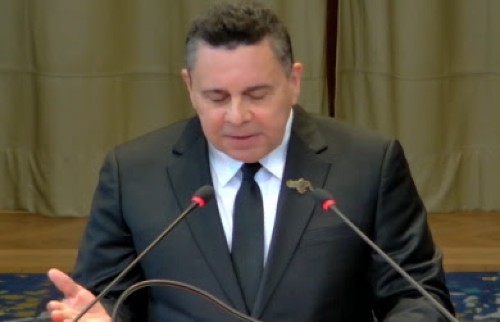 Samuel MoncadaVenezuela’s representative, Samuel Moncada told the ICJ that in the consultative referendum held on December 3, 2023, “the Venezuelan people clearly expressed their rejection of submitting this dispute to the court’s jurisdiction.
“This reflects a consistent course of action in terms of sovereign will,” he said, adding that “Venezuela is here today to respond to Guyana’s erroneous and misleading narrative and to set straight the true legal framework of the territorial dispute and the limits imposed also by international law and the Geneva Agreement on Guyana’s attempt to fraudulently transform the dispute and its obligations”
Guyana brought the case before the ICJ in 2018, seeking affirmation that the 1899 Arbitral Award, establishing the boundary between the two countries, is legally valid. The award had been accepted for over 60 years before Venezuela declared it null in 1962 and revived its claim to the territory.
The matter is being addressed under the 1966 Geneva Agreement, which outlines mechanisms for a peaceful settlement. After bilateral efforts failed, the dispute was referred to the ICJ by the United Nations Secretary-General.
The court has already ruled that it has jurisdiction to hear the case, paving the way for hearings on the merits, during which both sides will present full legal arguments.
The ICJ said that in the first round of oral presentations lasting two sessions of three hours, both Guyana and Venezuela will make presentations and it will continue on Friday ending on Monday next week.
The Essequibo region comprises roughly the western two-thirds of Guyana spanning 61,600 square miles. It is a resource-rich region bordered by the Essequibo River to the east and Venezuela to the west, which Venezuela claims as its own.
Moncada said that Venezuela has a long tradition of historical rights over Guayana Saquiba, derived from the presence of the Spanish Empire and the Republic of Venezuela for centuries. “The Saquiba River is named after the Spanish explorer Juan Esquivel. The Netherlands came to the territory while it was still part of the Spanish Empire, gaining independence in 1648 through the Treaty of Monster, the very same treaty in which Spain recognised the Netherlands’ claim to the territory east of the Saquiba River.
“The Spanish Empire was very clear about its possessions in Guayana Saquiba and defended them against the Dutch in an ongoing effort to expel illegal intruders, therefore demonstrating its control over the territory.”
Moncada, who appeared before the ICJ wearing a lapel pin of the purported map of Venezuela that includes Guyana’s Essequibo region, said Venezuela has presented an exhaustive list of maps demonstrating the existence of Dutch possessions to the east of the Saquiba River and Spanish ones to the west.
“If that weren’t enough, the British themselves have confirmed this very same reality. Just one man paid by the British Empire to justify its territorial greed in the quest for gold, the German Robert Schomburg, came along from 1835 to draw an arbitrary line on Venezuelan territory that then was an attempt to impose as a border.
“Venezuela never recognised that criminal act, which was not perpetrated by a naturalist explorer but by an agent of the British Empire. The British entered our territory in the years that followed, following the arbitrary Schomburg line, and then in 1897 and 1899 they sought to legitimise that theft.”
Moncada said that Venezuela’s struggle for its territorial integrity and its independence has been continuous, noting that “our territorial rights over Guayana Saquiba were systematically eroded during the 19th century by the British Empire, which sought to appropriate half of our territory.
“There are many examples of provocations that occurred from the 1850s until the 1890s, a time when British consuls were sending communications to London, conspiring to seize territory, to incite civil conflict, and to try to purchase territory, Venezuelan territory, ultimately then resorting to military action.”
Moncada said despite attempts at direct negotiations, peaceful negotiations, diplomatic negotiations, despite proposals for arbitration and international mediation, the voracious British Empire, the largest empire in the world in the 19th century, could not satisfy its own greed.
He said it was only the intervention of the United States of America in 1895 that forced the British to accept an arbitration.
“Although Venezuela entrusted the fate of its territory to the supposed goodwill of the United States, unfortunately the United States was not acting as a mediator to help Venezuela, but rather to impose its own will across the entire continent and to force the British Empire to recognise it as the new power.
“This was essentially a revival of the Monroe Doctrine, not the 1823 doctrine, which was originally a defensive measure, but the version of 1895, which sought to impose U.S. sovereignty over the entire hemisphere.”
The Venezuelan representative said that the Treaty of Washington of 1897 and the fraudulent Paris Award of 1899 became, for specialists in the matter, key milestones marking the moment when the United States began to replace the British Empire and the European powers across the entire continent.
“President Cleveland himself acknowledged this…in 1904, when he highlighted the great benefits of the 1899 award,” he said, adding that the “fraudulent award, which will be addressed by our experts, was imposed by the two most powerful nations in the world.
“This marked the climax of the infamous gunboat diplomacy and the treaties imposed by force in Asia, Africa and Latin America. Venezuela itself, in 1902, just halfway between the 1899 award and the 1905 delimitation, was blocked and bombed by the United Kingdom, Germany and Italy”
Moncada said in 1904, the United States threatened to invade Venezuela in a classic example of the well-known policy of the big stick.
“Only those who are ignorant of Venezuela’s history or those who denigrate its history would claim now that our country should have acted at that time under the illusion of perfect equality among states.
“The reality is far more bitter. All of these experiences endured by our people have taught us to strive for peace, but always without expecting favours from large powers or miraculous results from rigged international arbitrations.
“This is what led to our tradition of not recognising the jurisdiction of arbitral tribunals or courts of any kind when it comes to matters relating to our territorial integrity. This is why Venezuela does not accept the jurisdiction of the International Court of Justice, which was erroneously imposed in the 2020 judgement.”
Moncada said Caracas “respectfully rejects its jurisdiction to hear and decide on this dispute, adding that the decolonisation process that took place after the Second World War created an appropriate international framework in which both independent republics that had been stripped of their territories by the empires and colonised nations could have the opportunity to initiate claims for compensation or restitution for damages suffered at the hands of the great powers.
“The United Nations and its decolonisation committee provided a platform for many countries so that they could begin, in the context of international law and without the threat of force, negotiations with imperial powers with the aim of restoring their historical territorial rights.
“Venezuela has been at the very forefront of the struggle around the decolonisation of peoples worldwide and non-autonomous territories worldwide, including its own,” he said, adding that “therefore, it is very clearly an anti-imperialist conduct.
“It is impossible now to deceive international public opinion by trying to portray Venezuela as a country that poses an existential threat to its neighbours. All the decolonisation processes around the world, including that of Guyana, have had the support of Venezuela.”
Moncada said the Geneva agreement is an instrument of peace that encourages parties to find, through direct negotiation, a practical and satisfactory solution to their differences.
“This is the opposite of a court-imposed decision, where, inevitably, one party wins at the expense of the other’s defeat. When the parties commit in the Geneva agreement to overcome the disastrous legacy of colonialism within a framework of friendly and mutually beneficial relations”.
He said despite Guyana’s repeated assertions, the Geneva agreement of 1966 remains the legal framework that governs this matter.
“This agreement expressly recognises the existence of a territorial controversy,” he said, noting that the territory is subject of dispute between the parties.
Moncada said as a result, the characterisation by Guyana of an alleged threat to its territorial integrity or to its sovereign territory “constitutes a flagrant misinterpretation and a deliberately misleading presentation of both the facts and the law.
“Guyana has no established title under threat. Rather, what we see is a territorial dispute, an unresolved dispute, which is expressly recognised as such in the Geneva agreement and which must be resolved in a manner that is mutually acceptable to both parties.’
He recalled that when Guyana made its oral presentation on Monday, it sought to reverse the clear terms of the Geneva agreement, ”disregarding in this way more than six decades of bilateral practise, including the sustained negotiations and the good offices process, which were conducted under the auspices of the UN Secretary-General.
“My question is how do we understand then that throughout those decades, the Secretary-General, acting within the framework agreed by the parties, was promoting the effective destruction of Guyana or the dismemberment somehow of its territory when he stated that the objective of his good offices, as provided for in Article IV of the Geneva agreement, was to ensure a mutually satisfactory solution to the controversy?,” Moncada asked.

