


CASTRIES, St. Lucia - Antigua and Barbuda Prime Minister Gaston Browne has said that the visa policy of the United States is undermining trade, commerce “and even our students who require a visa to study in the United States.
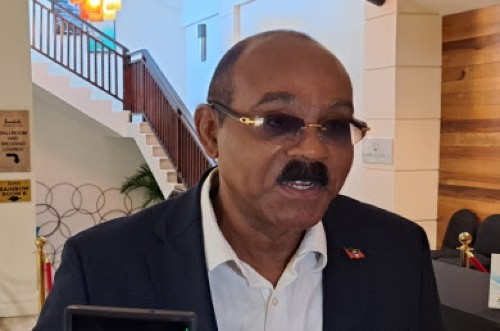 Prime Minister Gaston Browne speaking to reporters at the CARICOM summit in St Lucia (CMC Photo)“We also have individuals who like to visit their relatives in the United States, and they too are affected,” Browne told reporters on the sidelines of the 51st Caribbean Community (CARICOM) summit now underway here.
Visitor visas for citizens of Antigua and Barbuda are limited to a single entry and valid for three months. This replaces the old rules that allowed 10-year, multiple-entry visas. Additionally, some applicants may be required to post a bond up to US$15,000. Washington also approved new immigrant visas to Antiguans primarily driven by security concerns surrounding the country’s Citizenship by Investment (CBI) programmes.
Under the CBI, foreign investors are granted citizenship in Antigua and Barbuda in return for making a substantial investment in the country’s socio-economic development.
Browne told reporters that his country had remained hopeful that the visa policy would be “a temporary measure and that it will not be extended
“I believe that it would have fallen on July 1st, even though we have not heard formally from anyone in the U.S. We’re still hopeful that now that July 1st has actually come, that it will not be repeated.
“We haven’t heard any words from the United States to confirm whether or not they’re going to extend it or if it falls away. Again, we hope that the latter will prevail and that the restrictions will fall away because at any day we have absolutely no issue in the United States.”
Browne insisted that his country has “very strong relations” with Washington and has been “fully cooperative with the US.
“We consider the US to be our most important partner in development, he said, noting that 80 per cent of what is consumed in his country comes from the United States.
“Our most significant source market for tourists is the United States, and so for us, our development is inextricably linked to that of the United States. And we continue to work harmoniously with the US,” he said.
He said on the issue of allowing the United States to send illegal migrants from third countries to Antigua and Barbuda, though controversial should be undertaken in a manner that protects the security of the Caribbean island.
“All we’re seeking to do here is to protect our country to make sure that we do not attract criminal elements to our country. But we have indicated to them that we will certainly participate in the third country nationals programme.
We also want to make sure that we do not have more than we can accommodate. In other words, we have very limited capacity. We’re a small island with 100,000 people. We also have limited financial capacity, limited housing space.
“So we have to be very prudent in the way in which we negotiate with the United States,” he said, adding negotiations have not been concluded as yet, ”but the negotiations are active.
“And we’re hoping that we will get an acceptable agreement, one that precludes any criminal elements whatsoever to come to our country, and one in which we will have an amount of individuals to contend with within our own limited capacity.”
Prime Minister Browne said there is no irony to the fact that some Caribbean countries are willing to enter into agreements with the United States to allow third country migrants into their homeland, while implementing barriers to Caribbean nationals.
“Well, there’s no such irony in Antigua and Barbuda. I can speak for Antigua and Barbuda, and I’ll go as far as stating that there’s no other country in the Caribbean that is more representative of CARICOM than Antigua and Barbuda.
“We have had a very generous immigration policy in which we have accommodated tens of thousands of CARICOM nationals to our shores, almost invariably. Whenever they fall out of time, we, every four years, every five years maximum, would have extended an amnesty to help them to regularise their status.
“So, we have been the most welcoming country of all countries in the Caribbean of CARICOM nationals. In fact, Antiguans and Barbudans, generally, are very open, very welcoming to others. And I think that’s one of the strengths of our country, that it has added to the diversity of our country.”
Browne said that there’s no doubt that those immigrants who have come to Antigua and Barbuda “would have helped to build the country alongside the nationals who have lived there all their life.”
Browne said that he would have liked for the Caribbean to have a united position on the third country migrant issue , noting “unfortunately, that has been very difficult.
“Several countries have already signed the TCN (third country national) agreements and there seem to be some, maybe reluctance, fear among some, to have that type of coordinated approach.
“But I think that is what was required from the onset for us to have had a regional approach, because at the end of the day, we are far stronger together than alone. So what has happened, unfortunately, is that the countries have been negotiating bilaterally without any form of regional input.”
He said that in itself “would have exposed each of us, make us weaker, and obviously would have reduced our negotiating power.
“We have been a strong advocate for a regional response and the discussions continue up to today among those of us who have not signed. But I can’t say that we necessarily have a consensus.
“I believe, though, that there will be a general statement coming out from this conference expressing concerns and bringing to the attention of the United States the limited capacity of these countries and the potentially devastating impact of attracting criminals to our shores.
“We just cannot encourage or engage any form of armed criminals coming to our shores. Now, I have to add here, at no point in our discussions the US indicated that they were sending criminals.
“From the onset, when they raised the issue with us back in August of last year, we responded in writing and indicated that we would not accept any criminal elements.
“Now, our fears are evidently based on certain comments coming out of Washington by senior members of the U.S. administration who have said that they do not want any paedophiles, any criminals in a country, foreign criminals, and that they will deport them to third countries.
“So that is what is driving our fear. But I have to admit that in terms of formal requests, we have not had any formal requests from the United States to send us any criminal elements. But out of the abundance of caution, we are ensuring that the agreement specifies that these individuals are not criminal elements.”
Prime Minister Browne also sought to address the announcement by the European Union that the island phases out its CBI programme by June 2028 regardless of how well it is managed.
Europe said that the CBI is now a self-standing ground for suspending visa-free access.
“We have been negotiating for years now with the European Union. They have argued that our CBI programmes allow individuals who ordinarily they would not give a visa to access the European Union by virtue of having our citizenship.
“So we eventually negotiated a carve out for a phase out for those who wish to discontinue their programmes. The problem that we’re facing though, these programmes are so important to these small vulnerable countries, that ending our programmes may not be the most viable option.
“In the case of Antigua and Barbuda, we earn about US$100 million a year annually from it.It’s non-tax revenue. There’s no way we can contemplate taxing our nationals to cover that US $100 million and we do not have any known avenue of recovery of this time.
“So we may well more than likely take the position that we’ll continue our programme. And we accept that, look, countries have the right to determine their immigration policy. And if it is such that they do not wish to have visa-free access anymore for security reasons and other reasons, we have to respect that.”
He said Antigua and Barbuda would just have to realign and to reposition its rogramme to make sure it can continue to attract immigration investors “who can invest in our country, who can bring resources to our country, who can bring skills to our country”.
Browne said that he would also like a unified position among the Organisation of Eastern Caribbean States (OECS) on the issue.
“I believe when we get to Dominica that we will have some time to huddle and to respond formally. But we, again, are better off responding together rather than doing it alone,” said Browne, who is also the chairman of the OECS sub-regional grouping.

