


KINGSTON, Jamaica – Jamaica is preparing to launch a National Action Plan on Women, Peace and Security (WPS), aligned with the global framework that recognises women’s critical role in conflict prevention and resolution.
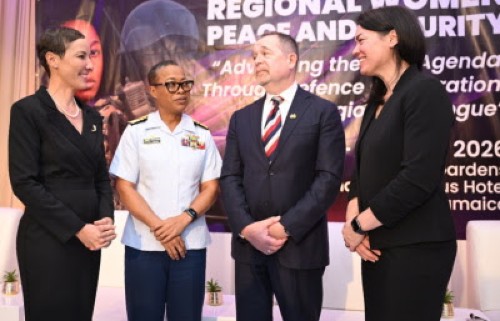 “Before the end of this month, a consultative inter-Ministerial meeting on Jamaica’s Women, Peace and Security National Action Plan will be convened at the Foreign Ministry,” Foreign Affairs and Foreign Trade Minister, Kamina Johnson Smith, told a three-day symposium being hosted by the Jamaica Defence Force (JDF) in collaboration with the Canadian Directorate of Military Training and Cooperation (DMTC).
Johnson Smith explained that ministries, departments and agencies (MDAs) with mandates under the WPS agenda, together with civil society groups, will convene to explore how the government can further institutionalise a gender-responsive approach to security governance, strengthen systems to protect women and girls from gender-based violence, cybercrime, and human trafficking, and promote women’s meaningful participation in peacebuilding and security decision-making.
“In keeping with a whole of society approach, we will also begin engaging with key partners and stakeholders across the private sector, civil society and academia,” she said, noting that the framework under development will align global commitments with national priorities, ensuring that international principles are translated into concrete actions tailored to Jamaica’s unique security and development needs.
“Our support for the WPS agenda is etched in the firm belief that women must be recognised for their invaluable role at all levels and, accordingly, be provided with opportunities to participate in both restoring broken communities and sustaining international peace and security,” she explained.
Johnson Smith said that while Jamaica may not be able to prevent wars and conflicts, the country can strengthen its capacity to contribute to peacebuilding and the maintenance of peace.
She said that now more than ever, renewed focus is needed on the four core thematic areas of the WPS agenda: preventing conflict and violence; protecting women and girls and safeguarding their human rights; ensuring women’s full, equal, and meaningful participation in peace and security processes; and advancing gender-responsive relief and recovery.
“Jamaica recognises that these challenges demand, not only heightened focus but also strategic… deliberate action and pragmatic flexibility,” Johnson Smith said, noting that under her tenure, the government has deliberately elevated the WPS agenda across bilateral and multilateral engagements, even in the absence of a formal action plan.
Johnson Smith said that in Jamaica, women have been vital assets in addressing domestic security challenges, noting that targeted efforts have included increasing the number of women across all arms of the security forces and at every level.
“Within security and justice, our women are also at the helm of many decision-making bodies, processes and initiatives. We have a woman at the helm of the Multi-stakeholder National Commission on Violence.
“At the political and governance levels, women play prominent roles within the Ministry of National Security and Peace… as well as the Ministry of Justice and Constitutional Affairs, including the appointment of two female Ministers of State recently,” she added.
Johnson Smith further highlighted key public offices are led by women, including the Chief of Defence Staff, the Public Defender, the Director of Public Prosecutions, the Auditor General, and the President of the Court of Appeal.
She said that Jamaica’s high representation of women in leadership is rooted in the National Policy for Gender Equality, promulgated in 2011, the same year the Government enshrined in the Constitution the right to freedom from discrimination based on sex.
Johnson Smith said that Jamaica’s 10-year comprehensive National Strategic Action Plan to Eliminate Gender-Based Violence (2017-2027) stands as one of the Government’s principal instruments for applying a gender-responsive lens to conflict resolution and societal stability, with particular focus on addressing violence against women and girls.
“These policy and legislative measures, which include the Sexual Harassment Protection and Prevention Act and the Domestic Violence Amendment Act, collectively reinforce our commitment to the principles of Resolution 1325 and the broader WPS agenda.”
Johnson Smith assured that Jamaica is committed to embedding the Women, Peace and Security principles within national development planning and institutional practice, thereby advancing peace and security for the benefit of Jamaicans while contributing to regional and international stability.
“For Jamaica, gender equality is more than a core objective. It is an important instrument for achieving inclusive sustainable development and the country’s National Development Plan – Vision 2030.”
Meanwhile, Johnson Smith said that dismantling gangs and neutralising dons must be recognised as measures directly protective of women and girls and should form a critical element of a successful WPS agenda for Jamaica.
She said that this is important because gangs rule by fear, exploiting mothers and their daughters both economically and sexually.
The Regional WPS Symposium, which ends on Wednesday serves as a high-level platform for regional military, governmental, and civil society stakeholders to engage with critical issues at the intersection of gender, peace, and security.

