


GEORGETOWN, Guyana - Guyana is celebrating its 60th anniversary of political independence from Britain, restating its position regarding the border dispute with Venezuela and declaring the country to be one of the world’s fastest-growing economies.
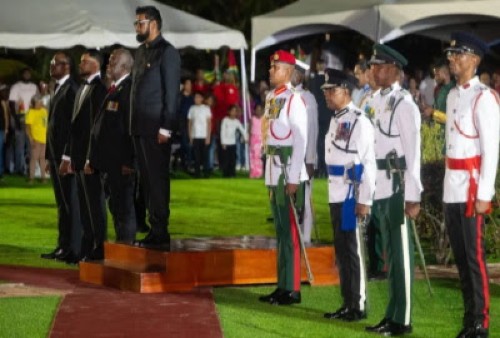 President Irfaan Ali, at the Flag Raising ceremony in Fort Island on Monday nightPresident Irfaan Ali, speaking on Monday night at the Flag Raising ceremony held at Essequibo, a 159,500 square mile mineral and oil-rich territory that makes up roughly two-thirds of Guyana, delivered what many political observers said was one of his strongest public statements yet on the border dispute.
“The Essequibo is Guyana’s. It has never been Venezuelan. Nor was it ever Spanish,” he told the ceremony held on Fort Island,, making reference to the 1899 Arbitral Award as the anchor of Guyana’s legal position.
“Guyana has indisputably included Essequibo. It is and will remain Guyanese,” Ali said, noting that the choice of venue for the ceremony is a fundamental truth that the territory belongs completely to Guyana.
President Ali told the ceremony, which was also attended by visiting Barbados Prime Minister Mia Mottley, that Venezuela had publicly declared before the International Court of Justice (ICJ) earlier this month that Caracas would not accept a ruling in Guyana’s favour.
“This is not the language of a neighbour. This is not the language of international law. This is not the language of peace. That is why tonight, my language cannot be ambiguos,” said, Ali, the country’s Commander-in-Chief.
The ICJ, which has affirmed its jurisdiction to hear the matter, is due to hand down its ruling on the matter after both sides submitted memorials and concluded oral hearings. Guyana has expressed full confidence in its case.
Despite the firm tone, President Ali drew a clear distinction between Venezuela’s government and its people, extending what he called a hand of friendship to ordinary Venezuelans who, he said, share a common Caribbean and South American heritage with Guyanese.
“We hold no malice toward the people of Venezuela,” he said, adding that when the matter is resolved, Guyana stands ready to work with Venezuela toward a hemisphere that is safer and more prosperous for all.
Ali was equally clear, however, that Guyana’s defence of its sovereignty would be pursued through courts and diplomacy and not aggression.
“Never through war,” he said, expressing gratitude to the United States government, the Caribbean Community (CARICOM), the Commonwealth, the Organization of American States (OAS), and all partner nations around the world for their unwavering support of Guyana’s sovereignty.
“…on this 60th Anniversary of our independence, we say to all the people of those nations, and their governments, with immense gratitude in our hearts. Thank you for standing with us.”
In his address, Ali said that Guyana had grown from a young nation with a gross domestic product (GDP) of just GUY$229 million (One Guyana dollar=US$0.004 cents) to one of the world’s fastest-growing economies worth more than US$75 billion, Guyana’s 60-year journey since Independence has been defined by resilience, sacrifice, and transformation.
“We are today, the fastest growing economy on earth. Not in this hemisphere, not in the Caribbean – but on an entire planet. And we did that together as One People, One Nation, One Destiny. We did that as One Guyana,” Ali said recalling that Guyana was a fractured nation in 1966, shaped by colonial division and many predicting it would not survive.
Ali said that the International Monetary Fund (IMF) has confirmed that Guyana led the world with an average real GDP growth of 47 per cent per year between 2022 and 2024, with the country recording double-digit growth for six consecutive years.
Oil production from the offshore Stabroek Block now surpasses 915,000 barrels per day, making Guyana South America’s third-largest oil producer. And for the first time in Guyana’s history, the national budget crossed one trillion Guyanese dollars in 2024.
Per capita income, once recorded at around $340, is projected to approach $38,000 by 2028. While these numbers say a lot, President Ali drew a clear line between what those figures represent on paper and what transformation actually looks like for the Guyanese people.
Ali pointed to roads and bridges as the clearest evidence. He said between 2020 and 2025, more than 10,000 roads and 430 bridges were reconstructed and rehabilitated across the country, reaching communities that independence itself had left behind.
A landmark US$100 million STEM initiative, developed in partnership with ExxonMobil and anchored at the University of Guyana, was also cited as part of the foundation being laid for the next generation.
President Ali also pointed to Guyana’s Natural Resource Fund (NRF) as evidence that the country is managing its oil wealth with future generations in mind. The oil beneath Guyana’s waters, he told the gathering, is not the property of any government.
“It is a patrimony of our people. It belongs to every Guyanese who came before us, and to every Guyanese yet to be born,” Ali added.
He urged young people here to be responsible for the future direction of the country, adding they are not responsible for the divisions of the past but are fully responsible for the unity of the future.
“You are the generation that will fully, and irreversibly make Guyana whole,” he added.

