


GEORGETOWN, Guyana – The National Assembly Tuesday approved of legislation restoring the framework established in 2009 to provide benefits and other facilities to former heads of state.
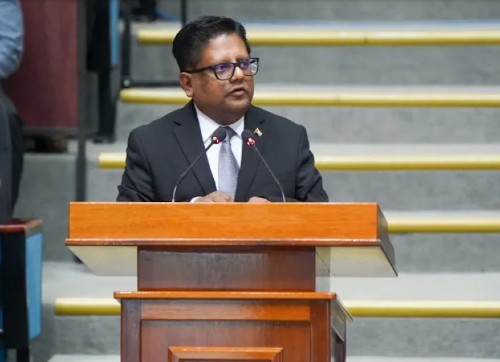 Finance Minister Dr Ashni Singh speaking in Parliament on TuesdayAs a result, former presidents will no longer be subject to the monetary limits imposed on several of their state-funded benefits in 2015.
The Former Presidents (Benefits and Other Facilities) Bill 2026, repeals the 2015 with the Senior Minister in the Office of the President with responsibility for Finance, Dr Ashni Singh, who piloted the measure, saying that it provides for utilities, household assistance, clerical and technical support, medical care, security and state-owned transportation, separate from the pension to which former presidents are entitled.
Singh told legislators that the bill ensures equitable treatment of former presidents, regardless of political affiliation, while removing provisions the government considers discriminatory.
Thirty-five legislators voted in favour of the Bill, while 26 voted against the legislation.
Opposition legislator, Tabitha Sarabo-Halley said that the legislation should not be reduced to a discussion about individual former presidents, particularly David Granger, whose circumstances had been repeatedly referenced by several parliamentarians
She said that legislation governing presidential benefits would have implications extending well beyond the current former presidents, questioning whether the removal of restrictions on private business and employment, alongside the restoration of extensive state-funded benefits, could create an unfair advantage for former presidents engaged in commercial activities.
She asked how the government would distinguish between expenditure associated with a former president’s personal residence and expenses arising from private commercial ventures.
She contrasted the proposed benefits with the financial pressures facing ordinary Guyanese, including housing costs, electricity bills, food, transportation and other household expenses.
Opposition legislator, Dr Terrence Campbell, questioning whether the government had adequately assessed its long-term cost, as he focused on the financial implications of the legislation.
He asked what the annual expenditure under the new framework would be compared with the 2015 legislation and how those costs could increase over the next 10, 15 or 20 years. The opposiion legislator also questioned whether an actuarial assessment had been undertaken.
But Government parliamentarians defended the bill, emphasising the need to preserve the dignity of the presidency, recognise the contributions of former heads of state and ensure their continued security and support after leaving office.
Public Works Minister Bishop Juan Edghill, said that the state should not have to renegotiate its recognition of former presidents whenever there is a change of government.
He told legislators that the presidency extends beyond political leadership, noting that the head of state represents the entire nation and must make decisions in the interests of all citizens, including those who may not have supported the administration. The minister maintained that former presidents should be given honour, respect and dignity.
“A state must not be left to negotiate gratitude to a president at the change of government,” Edghill said.
Minister of Parliamentary Affairs and Governance Gail Teixeira defended the legislation as an effort to correct what the government considers an injustice committed against former presidents in 2015.
Teixeira, drawing on her experience working with successive presidents since 1992, said that the responsibilities and personal sacrifices associated with the presidency justified appropriate support after leaving office.
She told the National Assembly that a former president should not be prevented from undertaking consultancy or other professional activities simply because he or she previously occupied the country’s highest office.
Attorney General and Minister of Legal Affairs, Mohabir Anil Nandlall, SC, providing a historical context on the legislation, recalled that before the 2009 framework, several facilities afforded to former presidents were provided through cabinet decisions, custom and practice. These included security, household support, overseas travel, transportation and medical assistance.
Nandlall said that placing the benefits in legislation provides certainty and prevents them from being arbitrarily withdrawn or altered by successive administrations. The minister also criticised the restrictive provisions introduced under the 2015 legislation, contending that they raised concerns about the rights and entitlements of former presidents.
Meanwhile, the National Assembly has approved GUY89.8billion(oneGuyanadollar=US0.004 cents) in supplementary spending, including funds to shield electricity customers from higher global fuel prices and to speed up a gas-to-energy project.
The Ministry of Finance said that the package includes GUY$11.3 billion for state power companies, eight billion dollars for the Guyana Power and Light to cover rising fuel costs rather than pass them on to customers.
“Fuel prices have skyrocketed worldwide,” Finance Minister Singh said, pointing to disruption in the Strait of Hormuz and its effect on crude oil and refined fuel prices.
Prices of refined petroleum products have risen by more than 50 per cent, depending on the product, and the statement quoted Singh as saying that the GUY $11.3 billion represents “an amount that would have had to be paid by the consumer” if the power companies had passed on the increase.
Lawmakers also approved GUY$24.7 billion for the gas-to-energy project, which will bring natural gas from Guyana’s offshore oil fields to a power plant on shore. Singh said the extra money was meant to finish the project as quickly as possible, so the government can deliver a promised 50 per cent cut in electricity tariffs.
The Public Works Ministry received an extra GUY$27.4 billion for roads, bridges and sea defences. That includes the road from Linden to Mabura and the Kurupukari bridge, part of a corridor south to Lethem on the border with Brazil.
Singh said that the corridor “holds the potential to transform Guyana’s economy in a way that we cannot begin to imagine,” adding that the government was already discussing linking it to a deepwater port.
The ministry statement said that other approvals included GUY$10 billion for old age pensions and public assistance, and one billion dollars for outstanding national cash grant payments. Registration for the grant will close at the end of November.

