


KINGSTON, Jamaica – Prime Minister Dr Andrew Holness, says the government’s decision to introduce new taxes this year was a last resort as his administration seeks to present a credible budget.
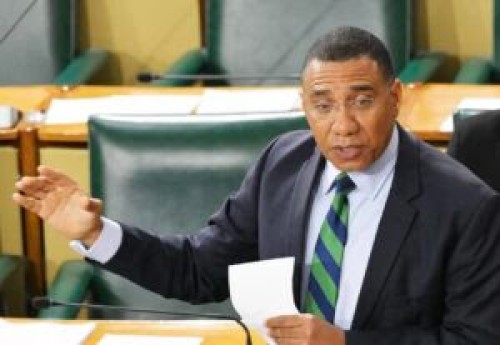 Speaking with journalists following the ceremonial opening of Parliament on Thursday, the Prime Minister sought to re-assure Jamaicans that the impact will not be significant.
The announcement of new taxes The Holness administration had enjoyed a decade long stretch of chanting the mantra “No new taxes!”
That came to an end on Thursday, when Finance Minister, Fayval Williams, unveiled a slew of new taxes.
Holness says the tax package was a last resort.
“We don’t take taxation lightly It is literally the last resort but we have to present to the people of Jamaica a credible budget so the people looking on what we propose can have confidence that what we’re doing will be to their benefit….”
He added that the unprecedented shock from last October’s landfall of Hurricane Melissa left the administration with few choices.
But despite the new taxes, the Prime Minister is says measures are in place to protect the vulnerable.
“I think when it it is stable and the public sees it. I believe there will be a significant understanding …I believe we have done as best as we could …and i ask for the understand of all Jamaicans. . we are not
The Andrew Holness administration is proposing new revenue measures that include increases in taxes on property, tourism activities, alcohol and cigarettes, and new taxes on non-alcoholic sweetened beverages and digital services.
The measures, to be implemented across two financial years, were disclosed earlier than usual to allow the Independent Fiscal Commission to review the Budget and provide its assessment of its credibility, said Finance Minister Fayval Williams who tabled the proposed revenue measures in the House of Representatives on Thursday.
The measures are part of the proposed national Budget for the 2026–2027 financial year that starts on April 1.
Under the new proposals, property taxes are set to rise following a nationwide land re-evaluation exercise by the National Land Agency, expected to take 12 months, with new rates taking effect in the 2027–2028 fiscal year, which will start April 1, 2027.
Tourism operators will face an increase in the GCT from 10 per cent to 15 per cent starting April 1, 2027, generating an estimated J$11.4 billion annually.
The SCT on alcohol will rise to $1,400 per litre of pure alcohol from $1,230 per litre, while the GCT on these beverages remains unchanged.
Public sector workers who import motor vehicles under the government’s 20 per cent duty concession will now pay GCT on these vehicles, bringing in an additional $1.3 billion.
Cigarette taxes are also set to increase, with the SCT moving from $17 to $20 per cigarette, projected to yield $1.1 billion.
A new SCT on non-alcoholic sweetened beverages, expected to take effect in the first quarter of the new financial year, is estimated to generate $10.1 billion in revenue.
Williams told Parliament that these measures are necessary to address the fiscal gap created by Hurricane Melissa, which struck Jamaica on October 28, 2025, causing US$8.8 billion in damages—approximately 41 per cent of GDP—and disrupting key sectors including tourism and agriculture.
“The passage and impact of Hurricane Melissa have materially altered the Government’s fiscal environment. The hurricane resulted in unprecedented damage to critical infrastructure, productive sectors, and public assets, placing severe pressure on public finances and reconstruction expenditure which is expected to extend across the medium term,” Williams told Parliament. “Against this background, expenditure containment and administrative improvements cannot close the emerging fiscal gaps.”
In a statement Wednesday confirming the impending taxes, Williams stressed that equity remains central to the approach. She sought to assure Jamaicans that “the most vulnerable will be protected” and that the new measures will be “calibrated, balanced, and sensitive to the realities facing households and businesses.”
The full Budget debate, which will provide further details on these and other measures, is scheduled for March.
Meanwhile, Opposition Leader, Mark Golding, is warning the government that the new taxes could cause a further slump in the Jamaican economy, adding that the government’s heavily bureaucratic approach has complicated the process
He was speaking with reporters following the ceremonial opening of parliament on Thursday.

