


Haitian Foundation Brings ‘Caribbean Voice’ to Global Debate on International Tax Cooperation
NEW YORK, New York – The president and chief executive officer of the New York-based Farah Delance Foundation, Farah Delance, says a “Caribbean voice” has been brought to the United Nations debate on the global framework for international tax cooperation.
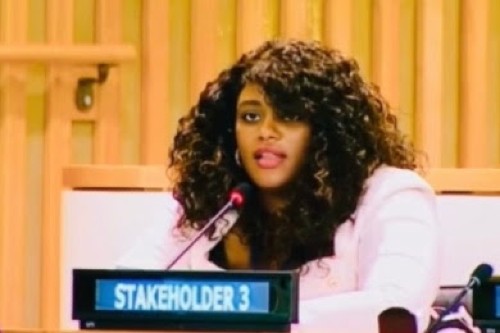 Farah DelanceDelance told the Caribbean Media Corporation (CMC) that she had “the privilege” of participating in the Fifth Session of the Intergovernmental Negotiating Committee on the United Nations Framework Convention on International Tax Cooperation earlier this month.
Delance said she brought to the discussion “a perspective rooted in Haiti, the Caribbean, civil society, women and youth, and the connection between public resources and human development.
“For me, the tax debate is not simply about percentages, corporate structures or technical provisions; It is ultimately about people. It is about whether governments have the resources to build schools, hospitals, roads and digital infrastructure.
“It is about whether young people can envision a future at home instead of believing that their only path to opportunity is migration. It is about whether developing countries have a meaningful voice when international rules governing their economies are established. And for Haiti and the Caribbean, these questions are particularly urgent.”
Delance said for Haiti, taxation, development and migration are connected.
“Haiti cannot discuss taxation separately from development. When a country lacks sufficient domestic resources to finance public services, infrastructure, education, health and economic opportunity, the consequences extend far beyond government budgets. They affect families, communities and ultimately migration patterns.
“My position throughout this engagement has, therefore, been straightforward: international tax cooperation must be connected to development. Haitians should not be forced to look outside their country simply because their homeland has been unable to mobilize and retain enough resources to create opportunity.”
She said that migration is a “complex phenomenon” and that taxation alone will not solve Haiti’s challenges even as she acknowledged that “responsible taxation, stronger institutions, transparency, investment and equitable international economic rules can contribute to creating the conditions in which people can choose to travel, study, work and build businesses abroad without feeling that leaving home is their only option for survival or advancement.
“For Haiti, the question should, therefore, be: How can international tax cooperation help countries mobilize the resources necessary to invest in their own people?. That question belongs at the center of the global tax conversation.”
Delance said Jamaica has also played a “particularly significant role” in the UN tax process, stating that that the country’s delegation has been “actively engaged” in the negotiations from the beginning.
She noted that Jamaican tax official Marlene Nembhard-Parker has served as a co-lead of Workstream III, dealing with the prevention and resolution of international tax disputes, alongside Germany’s Michael Braun.
“This is particularly significant for the Caribbean, because dispute resolution is not an abstract issue for small and developing economies. When countries have unequal negotiating capacity, access to effective and fair mechanisms for resolving tax disputes becomes an important element of protecting national interests.
“Jamaica’s participation demonstrates that Caribbean countries are not merely observers of the emerging international tax architecture; they have expertise and perspectives capable of influencing the rules themselves. The Caribbean cannot afford to be absent. The wider Caribbean has a direct stake in these negotiations.”
Delance said Small Island Developing States (SIDS), such as those in the Caribbean, frequently face a “difficult combination” of limited domestic markets, exposure to external economic shocks, climate vulnerability, high financing costs and significant development needs.
She said Barbados has “explicitly supported” the creation of an “inclusive, fair, transparent and equitable international tax system” and has argued that the United Nations is “uniquely positioned” to provide an inclusive forum for international tax cooperation.
Delance said Barbados has also advocated for stronger consideration of environmental and climate-related taxation within the international tax agenda.
“That Caribbean perspective is essential. The region needs an international tax system that recognizes that economic size should not determine the strength of a country’s voice.”
Delance said the negotiations have also revealed “significant differences” among member states, stating that the Terms of Reference adopted in 2024 received support from 110 countries, while eight countries voted against. Forty-four countries abstained, including Argentina and Trinidad and Tobago.
“The disagreement was not simply about whether countries support taxation or oppose taxation; the debate concerned questions of institutional authority, decision-making, scope, complementarity with existing international tax arrangements, and how commitments should be negotiated and implemented,” Delance said.

