


Barbados Gets Multi-Million-Dollar Loan to Modernise Water Infrastructure
WASHINGTON, DC – The Inter-American Development Bank (IDB) is providing an US$80 million loan to Barbados as the Caribbean country seeks to modernise its water infrastructure as it moves to address one of the most persistent challenges facing households, communities and businesses across the island.
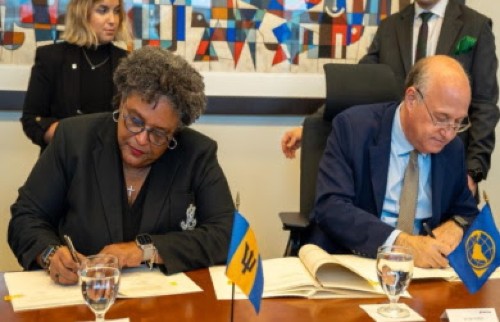 Barbados’ Prime Minister Mia Amor Mottley and President of the Inter-American Development Bank, Ilan Goldfajn, signing the agreement which will see US$80 million invested in the modernisation of Barbados’ water infrastructure. (GP)The US$80 million programme will be financed from the ISB’s Ordinary Capital resources and will be disbursed over a period of five years. Its structure reflects the need to address immediate infrastructure deficiencies while also strengthening the systems, skills and planning tools required for long-term water security.
The largest share of the investment, US$55 million, will go towards mains replacement that the Barbados authorities say is the core infrastructure intervention and one that strikes at the heart of frequent service disruptions and inefficiencies caused by an ageing network.
A further US$20 million has been allocated to non-revenue water management. This component is intended to reduce the high level of water losses within the system so that more of the water already being produced can reach consumers, improving efficiency, service reliability and value.
Institutional strengthening will receive US$2.5 million and will support targeted technical assistance and training in climate resilience and resource conservation, with the aim of giving the Barbados Water Authority broader access to green and innovative finance.
The component will also support the development of water sector plans and tools within the framework of the Water Resource Management Plan and the Water and Sanitation Master Plan, alongside community engagement campaigns to manage demand and promote conservation.
Another US$2.5 million has been assigned to programme administration and related costs, including dedicated staff within the Programme Execution Unit, audits, monitoring and evaluation, communications, supervision and implementation of the Environmental and Social Management Plan.
Prime Minister Mia Amor Mottley says water must be treated as central to the island’s development agenda, noting that Barbados is among the most water-scarce countries in the world and continues to contend with a high degree of non-revenue water.
“For us, water is at the centre of Barbados’ future economic development. We do not always look it, but we are one of the fifteen most water-scarce countries in the world, and for every gallon that is pumped, 40 to 50 per cent can be lost before it reaches anybody’s house.
“Being able to resolve these issues, with ageing infrastructure and recognising that there are technological gains to be made as well, means that we need the investment. I do not call it loans, but rather an investment in water to make us resilient,” Mottley said, noting that the water challenge in Barbados is too consequential to be addressed through piecemeal responses alone.
To date, less than five per cent of the island’s mains have been replaced. This new programme is therefore intended to support a deeper, more structured intervention that meets the scale of the problem.
Prime Minister Mottley also expressed appreciation to the IDB President, Ilan Goldfajn, describing him as a “trusted friend and partner”, noting also that the Washington-based financial institution has remained a steady presence alongside Barbados throughout its national reform and resilience journey.
“Since coming to Government, the IDB has walked every step of this journey with us. It is not just the financing. The technical assistance matters too, particularly at a time when the country must confront a very real skills deficit while still pushing ahead with urgency and purpose,” she added.
A government statement in Bridgetown said that the government views the programme as an important example of practical governance: identifying a long-standing national problem, building credible partnerships, and moving deliberately towards a solution that improves everyday life.
“For households, this investment represents the prospect of greater reliability. For businesses, it offers stronger operational certainty. For the country, it is a clear signal that water security is being treated with the seriousness it requires,” it added.

