


CASTRIES, St. Lucia – Prime Minister Phillip J Pierre says there is no “imminent withdrawal” of St. Lucia students studying medicine in Cuba, amid concerns that the United States has called on Castries to stop sending students to the Caribbean country.
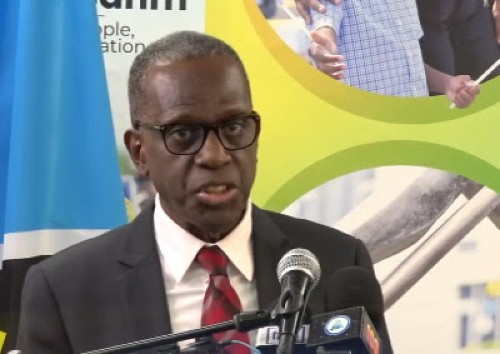 Prime Minister Phillip J Pierre speaking at the weekly cabinet news conference (CMC Photo)“The students, those who are in Cuba, will continue to be in Cuba. There’s no imminent withdrawal of students,” Pierre told reporters ahead of the weekly Cabinet meeting.
Last weekend, Pierre told the second World Congress on Racial and Ethnic Health Disparities meeting here that the US has called on St. Lucia to stop sending its nationals to study medicine in Cuba.
“I have a big problem. Many of our doctors got trained in Cuba and now the great United States has said we can’t do that any longer,” Pierre said.
But he told reporters that his administration is now exploring its options.
“First of all, we have to access where we are in terms of scholarships for our medical students. Secondly, we have to look to other countries,” Pierre said, making mention of Mexico and Africa for example.
“That is why it was so short sighted when a few people were so vehemently against us with the visit of the Nigerian President (Bola Ahmed Tinubu in July last year). The same people who are hypocritically crying now, pretending to care, when St. Lucia looked for other sources of support through Nigeria, they were the same people who were condemning and spreading all kind of propaganda.
“Right now they are certain countries in the region who have nurses from Ghana,” Pierre said, noting also the role of Cuban medical practitioners on the island.
He said nonetheless, government will be approaching Mexico, Nigeria, Ghana and Brazil for help in the event Castries has to implement the request from Washington, reminding reporters that the island cannot fight US policy, but would have to work around it.
“Basically the whole issue of the Cuban embargo…as you know last week, President (Donald) Trump declared Cuba a threat to American security. So we are just being proactive…we are friends with the American government, they are ur friends, we have excellent relationship with them…
“It will be a tremendous loss if the Cuban doctors can no longer come to St. Lucia,” Pierre added.
Cuba began offering significant, full scholarships to Caribbean and Latin American students to study medicine at the Latin American School of Medicine (ELAM) in Havana, which was officially inaugurated in 1999. The initiative was designed to train doctors from underserved communities across the region, offering free tuition, accommodation, and boarding.
Last month, the United States Embassy in Barbados said the Cuban regime’s “medical missions” programme, which has benefitted several Caribbean countries “relies on coercion and abuse.
“Cuban medical workers face withheld wages, confiscated passports, forced family separation and exile, restriction of movement through curfews and surveillance, intimidation and threats, and even pressure to falsify medical records and fabricate procedures. Many also endure excessive work hours and unsafe conditions,” the Embassy said.
Washington said it “is committed to exposing injustices and bringing an end to the Cuban regime’s coercive programme”.
Washington has also stepped its attack on the Cuban health brigade programme saying that the regime in Havana “is profiting off the forced labour of medical personnel and that “renting out Cuban medical professionals at exorbitant prices and keeping the profit for regime elites is not a humanitarian gift.
“It is forced labour. It treats the doctors as commodities rather than human beings and professionals. The United States calls for an end to the Cuban regime’s coercive and exploitative labor export scheme.”

