


KINGSTON, Jamaica – Jamaica has received 110 recommendations to strengthen its capacity to prevent, detect and respond to public health threats, following an International Health Regulations (IHR) Voluntary External Evaluation (VEE).
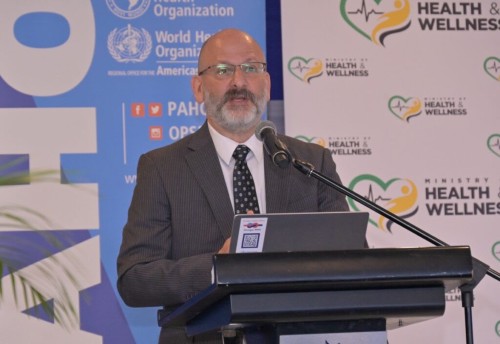 WHO/PAHO Country Representative for Jamaica, Bermuda and Cayman Islands, Ian Stein.Permanent Secretary in the Ministry of Health and Wellness, Dunstan Bryan, said the assessment identified several areas requiring targeted intervention over the next three to six years, including infection prevention and control, zoonotic diseases, human resources for health service delivery, and preparedness for complex hazards such as chemical incidents and radiation emergencies.
Bryan was speaking at the closing ceremony of the evaluation at the Jamaica Pegasus Hotel in New Kingston on Friday. His remarks were delivered on his behalf by Director of Emergency Disaster Management and Special Services at the Ministry of Health and Wellness, Dr Nicole Dawkins Wright.
He said the assessment also identified the need to strengthen Jamaica’s laboratory capacity for specialist functions, including genomic surveillance and antimicrobial resistance testing, as well as laboratory regulation, risk communication, subnational capacities and simulation-based preparedness.
The VEE assessed Jamaica’s public health sector core capacities under the IHR, along with the National Expanded Programme on Immunisation.
The 110 recommendations were based on analyses of key indicators, Jamaica’s self-assessment report, technical discussions, site visits and current national capacities.
Bryan said the assessment showed that Jamaica has a strong foundation on which to build, pointing to strengths including the national surveillance system and the country’s commitment to primary healthcare.
“The findings tell us that we have a strong foundation on which to build. Our assessment identified important strengths across Jamaica’s health security architecture, including our national surveillance system… our commitment to primary healthcare. These findings give us clarity. The responsibility before us is therefore to translate these findings into practical action through evidence-based structures for planning, investment, strengthening governance, training, coordination and continuous monitoring,” he said.
The evaluation involved international experts and representatives from across the Jamaican Government, reflecting the multisectoral nature of public health preparedness.
Implementation of the IHR in Jamaica involves sectors including agriculture, environment, transport, tourism, national security, foreign affairs, and science and technology.
WHO/Pan American Health Organisation (PAHO) Country Representative for Jamaica, Bermuda and the Cayman Islands, Ian Stein, said health security is a shared responsibility requiring sustained collaboration across sectors, institutions and all levels of society.
“WHO/PAHO remains fully committed to accompanying Jamaica in this next phase. We will use our plan as a practical mechanism to align the organisations with the priorities emerging from the VEE. We will work to ensure there is an immediate follow-up, and that it contributes to Jamaica’s longer-term health priorities in a coherent and sustainable approach towards health security and immunisation,” he said.
The evaluation process involved a collaborative examination of Jamaica’s systems, policies, capacities and practices.

