

Hair loss is often treated as a cosmetic concern, but for Black and Caribbean women it can involve questions of health, identity, culture and confidence. Susan Peterkin has spent years helping women and hair professionals understand what may be happening beneath the surface.
 For many Caribbean women, hair is closely connected to identity. The way it’s worn can reflect culture, age, profession, personality and personal style, while the rituals surrounding its care are often passed from one generation to the next. Braids, locs, extensions, wigs, natural styles, perms, pressing and other forms of styling offer Black women an extraordinary range of ways to express themselves.
Yet when hair begins to thin, break or disappear, the cultural significance attached to it can make the experience particularly difficult to navigate.
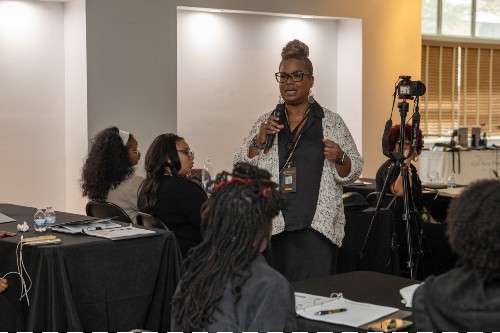
Susan L. Peterkin has spent more than four decades working with Black women’s hair, first as a cosmetologist and educator and, increasingly, as an advocate for greater awareness of scalp health and hair loss. Based in the Washington, D.C.–Baltimore area, Peterkin’s own experience with hair loss, together with what she learned through her collaboration with dermatologist Dr. Chesahna Kindred, changed the questions she began asking when a client sat in her chair.
“When a woman starts experiencing unexplained thinning, excessive shedding, changes in her scalp, pain, itching, burning or other persistent changes, our first response shouldn’t automatically be, ‘What product should we put on it?’” Peterkin says. “We should be asking, ‘Why is this happening?’”
For Peterkin, that question is important because hair loss can have many causes, some of which require medical attention.
“Hair loss comes off as an aesthetic concern, but it can be a symptom of a disease affecting the body,” she says. “That is why I believe we have to take hair loss seriously.”
Understanding the causes of hair loss
Peterkin’s work has exposed her to several forms of hair loss that are particularly important for Black women to understand, including central centrifugal cicatricial alopecia, or CCCA; traction alopecia; and androgenetic alopecia, commonly known as female pattern hair loss.
She explains that CCCA is a scarring form of hair loss that often begins in the center of the scalp and can involve itching, burning or tenderness. Because inflammation can damage the follicles, the resulting hair loss can become permanent. Dr. Kindred has also discussed associations between CCCA and conditions including hypertension, elevated lipid levels and fibroids.
Traction alopecia has a different relationship to styling. It can develop when repeated tension places stress on the hair follicles, particularly around areas such as the hairline. Tight braids, extensions, ponytails and weaves can contribute to that tension, especially when they are worn repeatedly or cause discomfort.
Androgenetic alopecia, meanwhile, can sometimes be mistaken for other forms of hair loss. Peterkin says Dr. Kindred has explained to her that it can resemble CCCA or traction alopecia while occurring without obvious scalp symptoms. That can make it difficult for someone without medical training to determine what is actually happening.
For that reason, Peterkin is careful about the role of the cosmetologist.
“I don’t have to determine which one it is,” she says. “As a cosmetologist, I need to recognize that something has changed and make sure my client gets to the professional who can.”
The responsibility, in her view, is to observe carefully, understand the limits of one’s training and help the client reach the appropriate medical professional when necessary.
The cultural weight of hair
Medical explanations are only part of the conversation. Hair also carries a cultural weight that can influence how women respond when they begin experiencing changes.
Peterkin grew up in Jamaica at a time when wigs and extensions were far less prevalent than they are today. She remembers the changing attitudes toward locs and Rastafarian culture, and eventually wore locs herself for 12 years. She loved the length she achieved, but eventually the weight of the locs became uncomfortable, particularly around the center of her scalp. At the time, she didn’t know that she had CCCA, and she ultimately cut her locs.
The experience changed the way she thought about the relationship between a woman’s attachment to her hairstyle and her awareness of her scalp. “Sometimes our attachment to a hairstyle can make it harder to pay attention to what our scalp is telling us,” she says.
Peterkin doesn’t want conversations about hair loss to become another critique of Black women’s styling choices. “There is beauty in that tradition, and I never want conversations about hair loss to become an attack on our culture,” she says.
She has worn locs, braids and extensions herself and continues to believe women should have the freedom to choose how they want to wear their hair. Her concern is whether they have enough information to recognize when a styling practice may be affecting their scalp.
“I don’t believe we have to reject wigs, braids or extensions to love our natural hair,” Peterkin says. “But I do believe every woman should have an opportunity to know, understand and appreciate the hair that grows from her own scalp… Our texture gives us tremendous versatility. I want us to enjoy that versatility without sacrificing the health underneath it.”
For Peterkin, one warning sign is particularly straightforward. “I have always said that a hairstyle should not hurt,” she says. “Our creativity and our cultural expression do not have to come at the expense of our follicles.”
When covering hair loss becomes part of the problem
The emotional impact of hair loss can make the issue even more complicated. A woman may choose a wig, braids or extensions because she feels uncomfortable with the changes she is seeing, doesn’t know where to seek help, or simply because styling her hair helps her feel like herself.
Peterkin understands that response.
“There are many reasons women conceal hair loss,” she says. “Sometimes it’s emotional. Sometimes it’s convenient. Sometimes they simply don’t know where to go for help. And sometimes a wig, braid or extension gives a woman an immediate way to feel like herself again while she’s dealing with something very difficult.”
She doesn’t believe women should be discouraged from using hairstyles that help them feel confident. Her concern is what happens when covering the hair also means that the underlying change is no longer being observed.
“I don’t have a problem with camouflage. My concern is when camouflage replaces observation,” she says.
Peterkin’s advice is therefore not to abandon wigs, braids or extensions, but to remain attentive to what is happening underneath them.
“If you’re experiencing hair loss, you can absolutely choose a style that makes you feel beautiful and confident,” she says. “But while you’re covering it, investigate it. Find out why the hair is disappearing.”
Knowing what is normal for you
Peterkin believes that one of the most useful things women can do is establish a sense of what is normal for their own hair.
She encourages women to pay attention to changes in shedding, density, the size of their ponytail, the hairline and edges, and areas where the hair repeatedly breaks rather than retaining length. Changes in the scalp are also important. Persistent pain, itching, burning or tenderness shouldn’t simply be accepted as part of having a particular hairstyle.
One of the tools she teaches is CHECK YOUR CENTER PART™. The process involves creating a center part, taking a clear photograph and periodically comparing it with earlier photographs.
“Is that part becoming wider? Are you seeing more scalp? Is the density at your crown changing? Are you noticing shorter hairs or areas that look different from your baseline?” Peterkin asks. The goal is simply to become familiar enough with one’s own hair to notice meaningful changes.
“You don’t have to become obsessed with your hair,” she says. “You simply need to know what normal looks like for you… Because when you know your baseline, you’re much more likely to recognize change early.”
When changes persist or cannot be explained by ordinary shedding or styling, Peterkin recommends seeking evaluation from a board-certified dermatologist, ideally one with significant experience diagnosing and treating hair and scalp disorders. She also believes that women of color benefit from finding practitioners who understand the particular concerns associated with Black hair and scalp health.
Why the stylist can be an important part of care
Peterkin’s work through S.T.R.A.N.D. (Stylists Training, Researching, and Networking with Dermatologists) grew from her belief that cosmetologists can play an important role in recognizing hair and scalp changes.
A stylist may see a client every few weeks and may have cared for her hair for years. That familiarity can give the stylist a detailed understanding of what the client’s hair normally looks like.
“If I’ve cared for someone’s hair for five, ten or fifteen years, I know her baseline,” Peterkin says. “I know what her density normally looks like. I know her hairline. I know her crown. I know how her scalp typically looks. I may recognize that something has changed before she does.”
The important question is what happens next.
“The hair professional can say, ‘I see something,’” Peterkin explains. “Dermatologists have the medical education and expertise to determine what that change means.”
S.T.R.A.N.D. was developed to strengthen that connection. Its hair-loss workshops bring dermatologists and cosmetologists together for education on hair biology, scalp disorders, scarring and non-scarring alopecias, medical treatments, ingredient safety and in-salon assessment. The program has trained more than 130 professionals and certified more than 106 cosmetologists through its workshops.
Peterkin wants that education to become part of the profession rather than something individual stylists have to discover on their own.
“Hair professionals are already on the front line,” she says. “They see hair loss every day in the salon. Without appropriate education, they may unknowingly continue services or practices that aren’t appropriate for what’s happening with that client’s hair or scalp.”
She is equally clear about the limits of the stylist’s role.
“We don’t need hair professionals diagnosing medical conditions,” she says. “We need them educated enough to recognize change, understand when something is outside their scope, document what they’re seeing and make responsible referrals.”
Changing the conversation around hair loss
For Peterkin, better care requires more than giving women a list of warning signs. It requires changing the way hair loss is discussed. She wants women to have the information to approach the issue earlier and with less fear. She also wants cosmetologists and dermatologists to recognize the value each profession brings to the process. The stylist may notice the change; the dermatologist can investigate its cause and determine appropriate treatment.
Dr. Kindred once described the relationship to Peterkin in a phrase that has stayed with her: “Cosmetologists and dermatologists are natural partners. We just weren’t communicating.” Peterkin believes that communication can lead to earlier recognition and, potentially, better outcomes.
For Caribbean women, the larger message is one of greater knowledge and agency. Women should be able to enjoy the cultural and personal versatility of Black hair while understanding the health of the scalp beneath it. They should be able to use wigs, braids, extensions or other styles without feeling that doing so means ignoring their hair’s condition, and they should be able to seek medical help without treating hair loss as something shameful.
Peterkin’s work is ultimately about making that knowledge more accessible: helping women understand their own hair, helping stylists recognize when something has changed, and creating stronger connections between the salon and the medical community.

