


PORT OF SPAIN, Trinidad – Trinidad and Tobago’s Minister of Tertiary Education and Skills Training, Professor Prakash Persad, Monday urged Caribbean Community (CARICOM) countries not to treat micro-credential as something separate and distinct from traditional education systems.
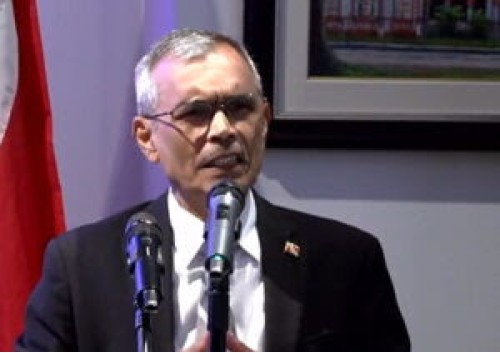 Minister of Tertiary Education and Skills Training, Professor Prakash Persad, addressing the CARICOM Micro-Credentials Sub-Framework Development and Planning for Caribbean Registry Roadmap opening ceremony (CMC Photo)Addressing the Commonwealth of Learning CARICOM Micro-Credentials Sub-Framework Development and Planning for Caribbean Registry Roadmap opening ceremony here, Professor Prakash Persad, said he believes that the education system should include micro-credentials.
“So it started at university level. I think it should continue at this primary and secondary levels, because there’s no point in having these changes at university level if the students face culture shock, education shock, whatever, at that level.
“So it must be a continuum. So that is something that we need to do,” he said, noting that when he was at the University of the West Indies (UWI) in the 1990s, he did a one week training course through the Caribbean from the Dominican Republic to Suriname.
He said the training was in programmable logic controllers, to update the industry in this sort of technology and that the course consisted of theory, tutorials and an industry-based practical test
“Now the participants received not a certificate of participation, but rather a certificate of competence, which was very novel then. And…we have to ask of ourselves today that when we spend time, when we spend money, training must be relevant to industry and it must serve to enhance the participants’ careers through validated certification.
“This is something that I think we need to look at in a serious way,” Persad said, noting that while he could only speak for Trinidad and Tobago, both the UWI and the University of Trinidad and Tobago (UTT) undertake regular consultation with industry, noting that the days of people at universities knowing everything are long gone.
“The walls between universities and industry gradually disappeared, ought to disappear a bit more. And we need to have more things with industry. So micro-credential would address this sort of issue.”
He said another important point is on online training which has become “much hyped” noting “there are serious limitations with online training.
“Now, online trading at higher levels, if you have a degree already, a bachelor’s degree, you’re doing your master’s, or you’re learning already in your field, then online trading is useful, maybe absolutely necessary.
“Now, at lower levels, in terms of a certificate coming up, I think we have to look at online trading in a serious way. We should not, you know, think it’s the answer to everything. Face-to-face training is still absolutely essential, …especially for some of these short courses.”
Persad told the delegates that this is something they have to bear in mind, adding “you know, we hear things like, you know, we hear AI (Artificial Intelligence). Everybody talks about AI We have to look at this serious.
“In the Caribbean, it’s a bit difficult, and our situation is a bit different from what’s happening elsewhere. So, in fact, just a few days ago, I said to students at some skill training institute that skills training is becoming more and more important.”
He said he told the students that they should not look down on skills training.
“And that’s a cultural thing we need to look at in the Caribbean, that hierarchy is still very important. All jobs are important. All jobs are important, and therefore, we should have that cultural change.
“So, part of making micro-credential important and acceptable, and especially with regard to skills training, we need to know and put this education out there that it is important, just as important and to back that up…
“We spend tens of billions of dollars in AI data centres. You know what’s the problem they’re facing? They don’t have mechanic, paediatricians, carpenters, et cetera. So, this is something we need. So, like I said, cultural change is important. Having all the nice regulations and rules, et cetera, without the society changing and accepting it, it won’t go very far.
Persad said that this is something the region must focus on a bit more going forward.
“So, what we’re saying and what we’d like to say to you that Trinidad and Tobago, and I’m sure the Caribbean also, we’re looking at how do we use it in an effective way,” he said, noting that he has read the two documents that will form the basis for the discussions here.
He said he is excited that one of the documents is looking at modules regarding certification “because what we’re doing, we’re telling people, look, do this a month, learn it, we test you in it, we certify you in it, and you can add it up.
“That’s how it should be. Summative assessments that we talk about, and this allows people to live and educate. See, for too long, we have this idea that young people, they have to give up their lives to go to university for three and four years, study day and night to get a degree.
“So in effect, you reduce your living. Micro-credentials allows you to live with your family, in other words, in a broad way, education and living balance, life balance and education balance.
“This is what we need. And this is something I think that we need to implement,” Persad said, noting that the line between a student studying for a degree and a worker seeking certification is becoming blurred.
“And therefore, again, I want to emphasise the point of education. To change the mindset is important. So part, I don’t know if, I didn’t read it, when I read it, I didn’t see the part of educating the public.
“I would suggest strongly that you do that…and in doing that, get industry on your side. Get industry on your side, so when the demand, this is what we want, industry says that, then educators will say, well that’s what we have to do.”
But he urged delegates to be wary of academic fraud, which he said is on the rise coinciding with the use of AI.
“So this is something that we need to do. So people can have their, as you call it, digital wallets, digital badges, whatever mechanism for implementation, that is something we need to do.”
He is urging regional countries to put such measures in place “but not only in the context of micro-credential” saying “it should be integrated into the education system and that the education system doesn’t start at university, it starts at the primary level”
He said Trinidad and Tobago is examining the possibility of developing “parallel tracks in the secondary school system.
“One for the so-called academic track, one for the skills track, all moving up to university level. So that way, nobody feels that skills training is inferior to academic. Because you have to ask yourself the question, would anybody here want a doctor who’s full of theory, but no skill in surgery operate on you?
“So this dichotomy of education skills being, no, no, it’s one, they have to be together, must be together and this is something we need to really emphasise, work on and put forward as we go forward in this issue,” Persad added.

