


PARAMARIBO, Suriname – Suriname has signed a five-year cooperation agreement with the United Nations Industrial Development Organization (UNIDO) designed to accelerate economic diversification and the local processing of raw materials and agricultural products.
 The Programme for Country Partnership (PCP) 2026–2031 is also aimed at assisting the Dutch-speaking Caribbean Community (CARICOM) country attract investment, strengthen entrepreneurship, and create more jobs.
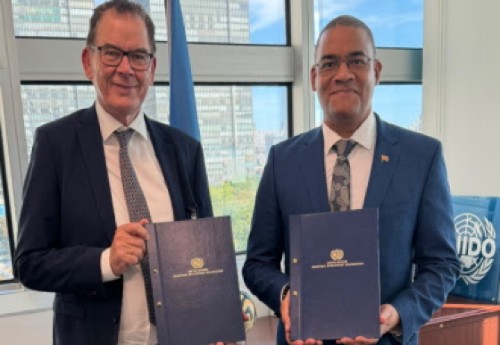
Economic Affairs, Entrepreneurship and Technological Innovation Minister, Andrew Baasaron, and UNIDO’s Director-General Gerd Müller, signed the agreement on the sidelines of the ongoing United Nations General Assembly in New York.
The PCP provides a framework within which government, business, development partners, and financiers can jointly develop projects and mobilize investments.
Baasaron said the programme aligns with the plans to base economic growth more strongly on sustainable diversification and in this regard, special attention is given to youth employment and entrepreneurship, the economic empowerment of women, digitalization, and the involvement of Indigenous and Tribal communities.
“Suriname has been set on a path of economic growth, based on sustainable diversification of our economy,” he said, adding that teams from government and UNIDO have been working on the elaboration of the program over the past few months.
The PCP rests on four pillars. The first concerns the improvement of policies, regulations, and institutions for sustainable industrial development. Additionally, enterprises must become more competitive, and agro-industrial value chains, green industry, and skills development are stimulated.
A third component is the mobilization of green and mixed financing for productive investments. The fourth pillar focuses on forest-related value chains and the development of the bioeconomy.
The programme also examines the potential development of Special Economic Zones (SEZs). Such zones could be used to stimulate investment, industrial activities, and local value creation.
Müller said UNIDO is willing to assist in developing a framework for sustainable economic zones. The aim of the PCP is to combine economic development with maintaining the position as a country with high forest cover and relatively low deforestation. Climate resilience, efficient resource use, and low-carbon development are therefore included in the programme.
For small and medium-sized enterprises, the PCP must offer opportunities to increase their production and competitiveness and to access financing and investments more easily. Additionally, the emphasis is on creating high-quality jobs, with particular attention to young people and women.

