


PARAMARIBO, Suriname, CMC – Suriname is positioning itself to become a major natural gas producer in the Caribbean and a new supplier of liquefied natural gas (LNG) to international markets, following a US$1.6 billion investment decision by Malaysian energy company PETRONAS and state-owned Staatsolie to develop the Sloanea gas field offshore Block 52.
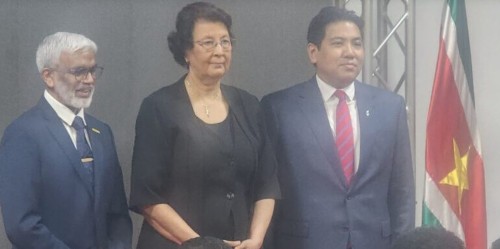 Suriname President Jennifer Geerlings-Simons (cenjter) flanked by PETRONAS president and Group chief executive officer, Tengku Muhammad Taufik (right) and Staatsolie’s managing director, Annand Jagesar at the signing agreement (CDS Photo) By Ivan CairoThe project, named KrakaWi, is expected to deliver its first gas in mid-2030 and will mark Suriname’s entry into offshore gas production.
The Final Investment Decision (FID), announced on Thursday at the Presidential Palace in Paramaribo, marks a major milestone in the country’s efforts to diversify its oil and gas industry. The development will include four offshore production wells, subsea infrastructure and a floating liquefied natural gas (FLNG) facility with an annual production capacity of approximately 1.5 million tonnes of LNG.
The Sloanea field contains an estimated 97 billion cubic metres of recoverable natural gas. The project is expected to have a production lifespan of approximately 25 years, offering Suriname the prospect of a relatively stable source of export revenue over an extended period.
PETRONAS holds an 80 per cent participating interest in Block 52 and is the operator, while Staatsolie, through its subsidiary Paradise Oil Company, holds the remaining 20 per cent. The two companies have been working together in the block since signing a Production Sharing Contract in 2013.
President Jennifer Geerlings-Simons announced the estimated investment of US1.6billion,describingthedecisionasanimportantstepinthecountry’senergydevelopment.StaatsoliewillcontributeapproximatelyUS320 million, corresponding to its 20 per cent participation, while PETRONAS will finance the remaining share.
Staatsolie’s managing director, Annand Jagesar, said that the company’s financing has already been arranged through an existing loan facility. He explained that the partners opted to lease the floating production vessel rather than purchase one, as acquiring such a vessel could cost between three billion US dollars and US$3.5 billion.
According to Jagesar, Staatsolie’s conservative projections indicate that the project could generate at least six billion US dollars in revenue over its 25-year lifespan. Actual earnings could be higher, depending on international gas prices and market developments.
The revenues accruing to Suriname will include royalties, the State’s share of production revenues and taxes. However, the precise annual contribution will depend on production levels, contractual arrangements and international market conditions.
The floating LNG facility planned for KrakaWi will be the first development of its kind in the Guyana-Suriname basin. It will enable natural gas to be processed and liquefied offshore before being transported by specialised vessels to international markets.
For PETRONAS, the project represents an opportunity to establish a new LNG supply source in South America and further diversify its global portfolio.
PETRONAS president and Group chief executive officer, Tengku Muhammad Taufik, said the investment reflects the growing importance of a diversified and resilient global LNG supply base. He reaffirmed the company’s commitment to working with the Surinamese government and Staatsolie to execute the project safely and responsibly.
The Malaysian energy company has also emphasised workforce development, technical training and greater participation by local suppliers and service providers.
The potential significance of Suriname’s offshore gas industry extends beyond the Sloanea discovery. Jagesar believes that the development of KrakaWi could make subsequent gas projects more economically attractive by establishing infrastructure, technical expertise and supply chains.
He has also pointed to prospects for another offshore gas development that could be at least twice the size of KrakaWi. Such developments could gradually establish Suriname as a significant gas-producing country.
PETRONAS is meanwhile expanding its exploration activities in other offshore areas. In deepwater Block 66, drilling is underway at two prospects, Senna and Picolet, to investigate potential resources estimated at approximately one billion barrels of oil equivalent.
PETRONAS has indicated that Block 52 itself contains nearly four trillion cubic feet of gas resources, including an estimated two trillion cubic feet of reserves. The block has also unlocked more than one billion barrels of oil-equivalent recoverable resources.
The company has expanded its presence beyond Block 52 through interests in other deepwater and shallow-water areas, including Blocks Nine and 10.
The KrakaWi project is not exclusively about natural gas exports. According to Jagesar, processing the gas could also make it possible to produce oil from certain reservoirs with relatively high gas content that might otherwise be difficult to develop commercially.
This could provide an additional incentive for further exploration and development in Suriname’s offshore territory.
The development also creates the possibility of bringing natural gas ashore in the future. Gas-to-shore infrastructure could provide a source of cleaner and more reliable electricity, while supporting industrial development and reducing dependence on other energy sources.
President Simons has stressed that Surinamese workers and businesses must be prepared to benefit from the opportunities created by the expanding oil and gas industry.
She told the National Assembly that agreements have been reached with PETRONAS concerning the training and education of Surinamese workers. The president noted that PETRONAS employs up to 90 per cent local workers in some of its other operating countries and expressed the expectation that Suriname would also achieve substantial local participation.
Jagesar has indicated that 16 Surinamese nationals are already employed by PETRONAS, while more than twelve Surinamese students are studying, or preparing to study, at the company’s university in Malaysia through cooperation with Anton de Kom University of Suriname.
The president also warned that the expected expansion of the oil and gas industry must be accompanied by responsible economic management. She highlighted the importance of the Savings and Stabilisation Fund and the Comptability Act to ensure that revenues benefit not only the present population but also future generations.
Among the challenges she identified are inflationary pressures, rising housing costs, additional demands on healthcare, education and infrastructure, and the risk of increasing inequality.
The government therefore wants future oil and gas revenues to support investments in other productive sectors, including agriculture, tourism, services and new industries, rather than allowing the economy to become overly dependent on hydrocarbons.
The road to the investment decision began with the Sloanea-1 gas discovery in late 2020. Further appraisal work, including the drilling and testing of the Sloanea-2 well in 2024, helped establish the commercial potential of the field. Staatsolie declared the discovery commercially viable on November 11, 2025, and approved the Field Development Plan on November 24, 2026, two days before the FID announcement.
The name KrakaWi, derived from Sranan Tongo, combines the words kraka (support or strengthen) and wi (we or us). It reflects the ambition that the project should contribute to the country’s collective development.
With the FID now in place, the project moves from studies and planning into implementation. If the schedule is maintained, Suriname will begin producing offshore gas in 2030, adding a new dimension to its emerging position as an energy producer in the Caribbean.
The challenge will be to translate the investment into sustainable national benefits, ensuring that local businesses, workers and future generations share in the opportunities created by the country’s offshore resources, President Simons said.

