


BRIDGETOWN, Barbados – The chief executive officer of the CARICOM Private Sector Organization (CPSO), Dr. Patrick Antoine, Tuesday said that the Caribbean could benefit from having trading relations with other global countries that its main traditional partner, the United State, but that it would require the region putting in pace a number of initiatives.
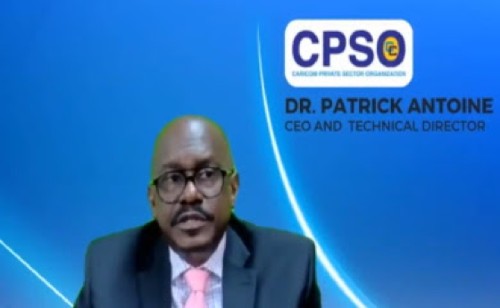 Speaking during a World Bank Group (WBG) sponsored online webinar, titled “Rethinking Regional Integration for Resilient and Inclusive Growth in the Caribbean,” Antoine, acknowledge the work that the regional private sector grouping has been doing with the Guyana-based Caribbean Community (CARICOM)Secretariat over the last two to three years.
The WBG said that the webinar provides a platform for dialogue on advancing regional integration across the Caribbean and Antoine said much of the work over the past months have focused on the CARICOM Single Market and Economy (CSME) that allows for the free movement of goods, skills and labour across the 15-member regional grouping.
He said it was also important to locate the CSME having regard to what’s happened with the America first policies and giving the member states of the region an opportunity to source more cost efficiently and otherwise imports that are critical to not only livelihoods in the region but also to the tourism sector.
“The tourism sector you know has a high import content and a lot of those imports we will see comes from the United States,” he said, noting that his presentation will be to operationalise the opportunities to source from alternative markets based on the country product combinations.
He said thar the region can in fact save up to US$2.4 billion or about 44 per cent of what is expended in terms of imports based on the numbers for 2024-2025.
“But I think the second message is that we really do have to focus to benefit from this in a true sense on trade facilitation and on what we call behind the board measures and also the commercial arrangements that will need to be put in place if we are ready to engage these opportunities.
“It’s not going to happen automatically because we are in fact in a context where we have done our commercial and trade relations with our main trading partner, the United States, for so long that it has really made us in terms of our institutional frameworks and structures heavily dependent on those arrangements including for commercial transactions settlements all of those things are going to have to be engaged”.
Antoine said that the region is in fact so dependent on the United States in terms of imports to the extent of about 43.7 per cent and we’re talking about imports with 2023-2024 estimated at US$11 billion.
He said in addition to this high dependence on US imports what’s happened in the last several years, especially with the America first policies is the reminder that “we need to diversify” and that a main part of that diversification ”now has to be placed on import costs.
“I think for us in economics this is particularly important because many of us would have learned over the years that you know small economies must take sort of the prices as exogenous this is the price is given to us and we focused a lot …on how we drive or diversify using sort of export thrust…..
“What this work is now telling us and in particular based on what’s happened in the last year or so is that there is a need for us to also focus on how we are to bring down import costs from import diversification and I think that’s really the focus of this work in the last two years and it’s actually going in a number of directions that all embassies and the private sector has been driving.”
He said an examination of the full spectrum of imports “tells us that the sort of mineral fuel imports are largely from the United States in short it’s not possible is the takeaway for us to diversify if we are looking at better prices and better arrangements away from the United States for those imports
“I think to put that in context when we look at the imports from the United States into CARICOM it’s important for us to recognise that the fuel imports would be among the 18 or 19 per cent of imports that we cannot diversify easily from the United States and I want you to take that away it means that about 80 per cent of the imports that we get in CARICOM … are imports that either originate in other countries or imports which have components which significantly are transformed in the United States for markets”.
Antoine said that this is important because it “tells us immediately that the scope for these import displacement opportunities are significant….and when we take out what we’ve called the non-assessed opportunities which is all the imports less than US$500,000 you can see that mineral imports will come from the United States.
He said that not a lot of displacement opportunities exist but as you go to mineral to machinery and electrical equipment to agriculture and food to chemicals “you will see that a lot of those imports can in fact be displaced let me say more competitively from other countries”.
He said the CPSO has been able to “look at country product combinations” and that a significant number in excess of 100,000 of those imports in fact can be more effectively sourced from other countries “not just from the than from the United States and that’s important”.
He said in terms of country product combinations 52 global partners can in fact supply the imports that the region takes from the United States more competitively and based on the CSME-US combinations at least five per cent of the imports from those markets are the imports that have been used as the threshold “so everything that we’re talking about are potentially quite strong the country product combinations we have sort of simplified to put into a chart which tells which country and we also have the country product combinations both from the CARICOM perspective
“…but importantly for this presentation is that of the top five countries that we can source from more competitively China would account for sort of 54.4 per cent of the imports that we are currently importing from the United States can in fact be imported from China more competitively and Spain again 49.4 per cent of the imports from the United States can be sourced more competitively and so on and so on right down to India…”
Antoine said 41.2 per cent of the imports from the United States that the region presently consume can in fact be sourced from India and “that’s again quite significant because it gives us a good sense of what the scope is and what we’ve done to kind of demonstrate the veracity of sort of the results that we’ve gotten is that we’ve actually looked based on the interest of our tourism sector “.
Antoine said that an examination of all the products for the tourism sector, “frozen beef for which we import about US36 million in the Community that you know we can source more competitively from Australia from Belgium from Canada from Spain from India and you can see the numbers which go with the countries tell you the following that 30 per cent of the sort of the price that we can import from the United States can be imported from Australia”.
He said that in the case of Australia, the region can import at 30 per cent less than the price its imports from the United States and in the case of Canada it can import at 38 per cent less.
“I think again this sort of gives you a spectrum of the countries and the products which we’ve been able to sort of indicate to a number of member states that have an interest what this would look like based on the import profile so I think again the takeaway is that if you were to look at sort of what is the distribution of the benefits that we can harvest from this alternative sourcing we see that the benefits would range from what we call an expected which is not the maximum …so we have an expected savings of US$1.4 billion and that’s quite conservative…”.
But he said in order to benefit from these figures, the Caribbean would have to put a number of measures in place noting that there are at the moment only two ports in CARICOM that are really heavily connected with “our global partners that we can source from”.
He said the most connected is the port of Kingston which has sort of 17 connections internationally but it’s also the port which connects to a number of CARICOM countries perhaps directly which is also a good option “as we look at how we’re able to benefit from what we call a hub and spoke arrangement in making a lot of these benefits that have spoken about from the rest of the world realisable”.
He said in the case of the port of Port of Spain, it is connected to about seven global partners that offer good alternative sourcing options to CARICOM “and of course that gives you a good sense of what the benefits could look like if we are able to establish hub and spoke arrangements between the rest of the world outside of the United States which of course remains the most connected”.
Antoine said growth in intra-regional trade has not been as rapid as the growth in extra-regional trade looked at in terms of imports and that there is a need to turn that around.
“… extra-regional imports has been about five times the growth of intra-regional exports and I think that’s really a key parameter for us because it tells us that we have a widening gap …that continues to widen and it’s widened even more after 2024, and so what you’re seeing is in fact a trend where notwithstanding our focus on 25 by 25 we have a widening gap in the regional trade balance between our countries trade and trade from the rest of the world and that is something which tells us that perhaps there may be opportunities and we’ve done that work which tells us that ”
He said that while opportunities exist there are 333 opportunities based on the most frequently traded products and of those opportunities there are 155 opportunities that are products that in 2001 ”our community said look we have to focus on enabling import…”
“ I also want to tell you that there are opportunities that we didn’t see in 2001 as opportunities that the region needed to put a sort of competitiveness structure around in terms of the CET the common external tariff and of those 431 what we call non-ineligible products, interestingly 178 of them actually turn out to be opportunities that the region can develop competitively and that’s a good sign”.

