


BRIDGETOWN, Barbados - The Guyana-based Caribbean Community (CARICOM) is conducting a readiness assessment examining how can the region develop bilateral trade arrangements that can contribute to its resilience and development in a manner that is different from the past.
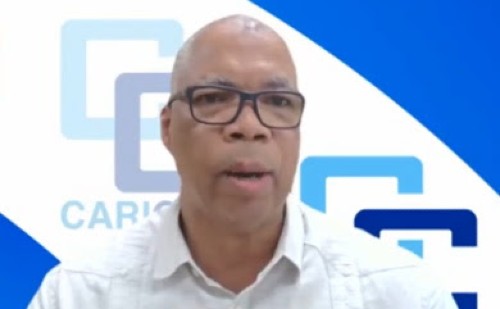 Ambassador Wayne McCook addressing the World Bank sponsored webinar on Tuesday (CMC Photo)CARICOM Assistant Secretary General on the Single Market and Economy (CSME), Ambassador Wayne McCook, Tuesday told a World Bank Group (WBG) sponsored webinar that teams have already been deployed to Suriname and Guyana conducting the exercise.
The WBG said that the webinar provides a platform for dialogue on advancing regional integration across the Caribbean under the theme “Rethinking Regional Integration for Resilient and Inclusive Growth in the Caribbean”.
Among the participants was the chief executive officer of the CARICOM Private Sector Organization (CPSO), Dr. Patrick Antoine, who said that the Caribbean could benefit from having trading relations with other global countries that its main traditional partner, the United State, but that it would require the region putting in pace a number of initiatives.
Antoine said much of the work over the past months have focused on the CSME that allows for the free movement of goods, skills and labour across the 15-member regional grouping.
He said it was also important to locate the CSME having regard to what’s happened with the America first policies and giving the member states of the region an opportunity to source more cost efficiently and otherwise imports that are critical also to the livelihoods in the region.
McCook told the webinar hat the late United Nations secretary general, Kofi Annan, had said once that reform is a process, not an event and similarly, regional integration is a process, not an event.
“And we are today building on a foundation laid some 50 odd years ago. The region has a mature trade and goods regime,” he said, noting that during his presentation, Antoine would have described how trade is integral to the current agenda of the region and its future development.
“But what is also important is that the region is built on a number of pillars, and that there is significant functional cooperation in health, in climate response, in disaster management and resilience, et cetera.
“ So if we’re to say, where do we stand in regional integration? We could go with a glass half full or the glass half empty. I think the positive approach is to look at it as a glass half full,” McCook said, noting that CARICOM is a community of sovereign states.
“So the integration process is based on a pooling of sovereign capabilities, competencies and decisions. And the implementation requires national action. We are doing all of this, of course, in a complex environment where the region is particularly vulnerable to significant exogenous shocks,” the senior CARICOM official said.
He said that an examination of where the region finds itself with regards to trade “we should measure where we have made progress” noting that intra-regional trade accounts for 12 to 16 per cent of regional trade.
“But what is missing in that is how manufacturing intensive that intra-regional trade is and how resilient it is and how connected it is to services. Equally, the region has a very strong services sector and the intra-regional trading services, while not, and you know this very well, measurement is not our strong suit.
“So data on the actual movement of services is not at this moment reliable. But we know from observation that things like free movement, the skills regime, the rights of establishment have made services, the delivery of services cross-border within the region much better.”
McCook acknowledged that there is still work to be done “and in fact, we do have right now in Guyana and Suriname a team from our external unit conducting what we call a readiness assessment.
“We have been asked to examine how can the region develop bilateral trade arrangements that can contribute to our resilience and development in a manner that is different from the past,” McCook said, noting that Antoine had identified the opportunities that exist for diversification.
“But we don’t want to just do this off the cuff. We are currently undertaking a significant analysis. Where do we stand in terms of the posture of our industries and businesses? What readiness do they have for external markets and which markets?
He said the initiative will be conducted in the member states and the plan is to come up with a regional strategy for this diversification
He said on the issue of transport and logistics, “we need to flip the script on the transport and logistics problem as we’re trying to do on the import challenge.
McCook said six billion US dollars in imports presents an opportunity for regional production and “equally, the vacuum that exists in regional logistics and transportation ought to be seen as business opportunities” referring to the hub and spoke as opportunities for business.
Meanwhile, the World Bank’s Country Director for the Caribbean countries, Lilia Burunciuc, told the webinar that the Caribbean is a region of individual resilience and also a region of immense potential, but it’s also shaped by a specific set of structural realities, small domestic markets, high exposure to external shocks, rising costs of trade, transport, and increasingly climate impacts.
“So, these are not new challenges, but they are becoming more complex, and any of the ones that I mentioned are becoming more complex. Climate impacts are complex, and more often, and more destructive.
“Now, trade is a huge issue, and so on, and so on. And they become also more urgent every time when we look at them. So, in this context, finding solutions, and often regional solutions, is not just an aspiration. It is a practical necessity to ensure a sustainable and viable future for generations to come.”
Burunciuc said for small states, there is no way around it. She said working together is often the only way to expand market size, attract investment, and deliver services to the people more efficiently.
“It is also important how the region can build resilience, and when we say resilience, it’s not just natural disasters. It’s also economic resilience. It’s also institutional resilience. It’s also social resilience.
“So, regional solutions can work and can deliver results, and actually, solutions that extend beyond regional boundaries is also important to look at, perhaps even rethought,” she said, adding that the webinar “is an opportunity to re-examine, reconsider, and rethink, and this work depends on strong partnerships with regional institutions, with governments, private sector”.
She said that the Caribbean regional agenda is enormous, adding “you know, there are many issues that are being dealt with and or need to be dealt with at the regional level.
“So, today, we’ll actually focus on one of them, on a very critical one, is on various options on trade and opportunities that lie in front of the Caribbean countries and opportunities for the region to move ahead on acting as one regional entity vis-à-vis the outside world,”Burunciuc said.

