


WASHINGTON, DC – The Pan American Health Organization (PAHO) is calling on countries in Latin America and the Caribbean (LAC) to strengthen menopause care within health services and adopt an approach that goes beyond symptom management to include the prevention of chronic diseases, mental and sexual health, and the promotion of healthy aging.
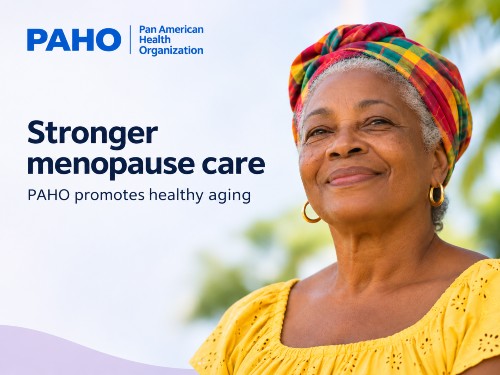 Statistics released during a PAHO-organized webinar, Guidelines for Menopause Care: Regional Overview, Experiences and Challenges in Latin America and the Caribbean, showed that of the 33 countries and territories examined, only 10 (30.3 per cent) had at least one identified, current national guidelines on the management of menopause.
In the remaining 23 countries, no national guidelines that meet the study’s criteria were identified.
“These findings show that we still have a long way to go to ensure adequate and timely menopause care in our region. We need evidence-based clinical guidelines that comprehensively address women’s needs and translate into accessible, quality health services,” said Suzanne Serruya, Chief of PAHO’s Women’s, Maternal, Neonatal and Reproductive Health Unit.
Menopause is a natural transition that can be accompanied by hot flashes, sleep disturbances, mood changes, and genitourinary symptoms that affect quality of life. Care for menopause also provides an opportunity to assess cardiovascular risks, prevent osteoporosis, and promote healthy lifestyles. Women may live nearly one-third of their lives after menopause, underscoring the importance of appropriate care during this stage.
PAHO has also warned that research on women’s health has historically focused on their reproductive years, while menopause has received relatively little scientific attention. Expanding the available evidence is essential to inform policies and health services that respond to women’s needs.
The regional analysis, conducted between May and July 2026, examined the availability and content of menopause care guidelines. Among the 15 documents reviewed in depth, the analysis identified the differences in recommendations covering diagnosis, treatment, prevention, and the organization of health services.
Although most addressed diagnosis and long-term health, gaps were found in recommendations for special clinical situations, such as premature menopause and a history of cancer, which require individualized care.
The analysis also highlighted that having guidelines does not guarantee their implementation and that there is a need to translate recommendations into effective care requires training health workers, establishing care and referral pathways, facilitating access to treatments, and strengthening follow-up. Primary health care plays a central role in symptom assessment, prevention, and providing guidance to women.
Meanwhile, a new World Health Organization (WHO) study has found that one in four adolescents worldwide reported not getting at least 60 minutes of physical activity on any day in the previous week.
According to new global estimates released by WHO, this amounts to some 240 million young people aged 11–17 years who reported not completing at least 60 minutes of moderate-to-vigorous physical activity on any day in the previous week. On average, adolescents reported being active for just 2.7 days a week, while only 14 per cent reported being active on all seven days.
The survey found wide differences in activity levels across the Americas pointing to substantial differences in adolescent physical activity.
In Latin America and the Caribbean only 13.8 per cent of adolescents reported at least 60 minutes of moderate-to-vigorous physical activity on each of the previous seven days, with a marked gender gap: 17.8 per cent of boys compared with 9.5 per cent of girls.
PAHO said that these patterns underscore the need to expand opportunities for adolescents to be physically active, while addressing inequalities both within and between countries.
It said that there is no single explanation for the lack of global progress. Physical activity is shaped by where adolescents live, learn, commute, play and spend their free time. Transport patterns, infrastructure and urban planning, access to safe public spaces, opportunities for safe walking and cycling, school environments, affordability, social norms and increasingly screen-based lifestyles can all influence adolescents’ opportunities to be active.
The challenge is not simply to persuade adolescents to move more. It is to create environments that make being active a normal and easy part of growing up.
WHO is calling for stronger action across the education, transport, urban planning, sport and health sectors, alongside efforts to address the multiple barriers faced by girls.

