


KINGSTON, Jamaica – The United Nations Food and Agriculture (FAO) said that the 20th edition of the Caribbean Week of Agriculture (CWA) which got underway here on Monday, is not only a milestone, but is a call for the region to move faster together from commitment to implementation.
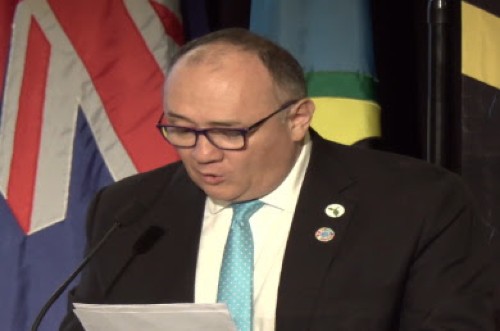 FAO Assistant Director-General, Rene Orellana Halkyer.“The Caribbean is advancing an ambitious transformation agenda. Countries are working to strengthen food security and nutrition, increase production and trade, reduce import dependency, and build resilience to climate and economic shocks,” said the FAO Assistant Director-General, Rene Orellana Halkyer.
He told the opening ceremony that at the same time, the region faces the growing burden of unhealthy diets and non-communicable diseases.
“These challenges are connected, and our response must be connected as well. The regional commitment to 25 by 2025 plus five gives this agenda renewed political momentum. At the same time, FAO is working with CARICOM (Caribbean Community) member states to translate that ambition into coordinated policies, investment, capacity, and results across the agri-food value chain.”
Halkyer said that the FAO is articulating its support as one broader sub-regional effort rather than as a collection of isolated projects by connecting production, trade, investment, resilience, and nutrition under one shared vision, more efficient, inclusive, resilient, and sustainable agri-food systems.
He said that the FAO is also working across the region on a practical competitiveness agenda, strengthening trade capacity with CARICOM, supporting business matchmaking with Inter-American Institute for Cooperation on Agriculture (IICA) and the CARICOM Secretariat to open market opportunities, and advancing digital agriculture, climate smart technologies, improved water management, soil analysis, crop and pest management, traceability, certification, and market access.
“Together with the stronger regional value chains and greater private sector participation, we are helping to expand production in agriculture and fisheries and deliver better results for Caribbean producers, agribusinesses, and consumers.”
Halkyer said that this transformation also requires direct attention to the vulnerabilities of Caribbean small island developing states.
He said climate change and extreme weather events continue to affect agricultural production, fisheries, rural livelihoods, and food security.
“ FAO is supporting countries to place resilience at the centre of investments and public policies, building practical evidence, strengthening technical capacities, and scaling solutions across the subregion.
“The same political logic applies to animal health, food safety and preparedness. FAO is bringing together technical cooperation in these fields and regional coordination through work supported by the Pandemic Fund, One Health simulation exercises, and Caribbean participation in global efforts against transborder animal diseases.”
The senior FAO official said that these efforts strengthen surveillance and regional capacities before crises occur. He said food security also means access to affordable, nutritious, and diverse foods.
“We are connecting nutrition, local production, and public procurement, including through school feeding programmes that can improve children’s nutrition while creating more stable demand for local farmers, fisherfolk, and agri-food enterprises.
“Farmers and fisherfolk must remain at the heart of this transformation. Policies, technologies, and investment will matter only if they improve livelihoods, strengthen businesses, and create opportunities for the people who produce our food. So must young people and women.”
Halkyer said that the FAO is supporting their participation, innovation, and leadership, including through the World Food Forum Youth Action Initiative and the expansion of its national chapters across the subregion.
He said these works contribute to making Caribbean agriculture more productive, profitable, innovative, and attractive to a new generation.
“Regional cooperation is therefore not optional. It is the condition for scale. We are precisely strengthening partnership with this view among governments, CARICOM, regional institutions, other United Nations agencies, and the private sector so countries can draw on complementary expertise, share knowledge, mobilise investment, strengthen markets, expand trade, and build supply chains that are better prepared for shocks.”
Halkyer said that the success of the CWA will be measured by what follows, adding that the experiences already emerging across countries are strategic references for a shared Caribbean pathway that can be adapted, scaled, and connected across the subregion.
The CWA is being held under the theme “The New F.A.C.E of Caribbean Food Systems” with the organisers indicating that it highlights four key areas, namely Food Security, Agri-Business, Climate-Smart Technologies and Export Expansion.
The week long event has brought together more than 600 delegates representing agriculture and fisheries ministers, farmers, fisherfolk, policymakers, researchers, private-sector representatives, development partners and youth from across the Caribbean to advance discussions on the future of regional food systems.

