


UNICEF, CCCCC Strengthen Partnership to Advance Child Centered Climate Action Across the Caribbean
BELMOPAN, Belize – The United Nations Children’s Fund (UNICEF) and the Caribbean Community Climate Change Centre (CCCCC) have signed a Memorandum of Understanding (MoU) that will strengthen collaboration to protect children’s rights and well-being in the face of the growing impacts of climate change across the Caribbean.
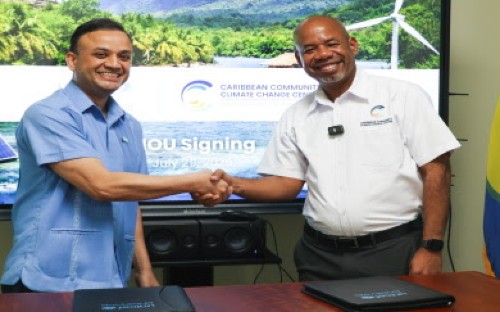 The five-year partnership establishes a framework for joint action to integrate child sensitive climate policies, build resilient social services, strengthen climate adaptation and disaster risk reduction efforts, and empower young people to participate meaningfully in climate action and decision-making.
Children in the Caribbean are increasingly affected by climate-related hazards, including hurricanes, flooding, droughts, extreme heat and environmental degradation. These impacts threaten access to education, healthcare, safe water and sanitation, nutrition and protection services.
Through this partnership, UNICEF and CCCCC will work together to ensure that climate responses better reflect and address the unique vulnerabilities and needs of children and young people.
“Climate change is not only an environmental challenge; it is a child rights challenge,” said UNICEF Representative Sajid Ali, noting that “children are among those least responsible for the climate crisis yet they bear some of its greatest consequences.
“This partnership with the Caribbean Community Climate Change Centre will help ensure that climate policies, investments and programmes across the region put children at the center and strengthen the services and systems they rely on every day.”
Under the agreement, the two organizations will collaborate to strengthen child-sensitive climate governance, support climate-resilient education, health, nutrition, water, sanitation and hygiene (WASH) systems, and promote child-responsive social protection and disaster preparedness measures.
They will also work together to generate evidence, mobilize resources, and expand knowledge on effective approaches to climate resilience that benefit children and communities.
CCCCC executive director, Dr. Colin Young, welcomed the partnership, noting that regional climate action must consider the needs and perspectives of future generations.
“It is a well-known fact that children and youth have not been a central focus of climate resilience programming, either regionally or globally. UNICEF brings a tremendous track record of advocating the rights of children and ensuring they are at the heart of climate resilience efforts.
“This aligns with the CCCCC’s strategy, and it is an area where we recognise the need for greater strategic focus and stronger partnerships for action,” Young said, noting that the MoU sets out the framework for the work “we will do together and allows us to combine our expertise to ensure that children are at the heart of climate action.
“We are absolutely delighted to be partnering with UNICEF and to draw on its extensive experience working with children and youth across the Caribbean and in Belize.”
The two organisations say a key area of collaboration will focus on strengthening climate-resilient safely managed sanitation services throughout the Caribbean.
They said drawing on UNICEF’s global and regional expertise in sanitation, the partnership will support evidence-based advocacy, capacity development, knowledge-sharing and climate financing initiatives to improve sanitation systems and resilience, particularly in climate-vulnerable communities.
The partnership will also place a strong emphasis on youth engagement, supporting children and young people, including adolescent girls and marginalized groups, to develop the knowledge, skills and leadership needed to contribute to climate solutions, policy dialogue and advocacy at national and regional levels.
“By combining UNICEF’s mandate to advance and protect children’s rights with CCCCC’s leadership in coordinating regional climate action, the two organizations aim to accelerate progress toward a more resilient, sustainable and equitable Caribbean where every child can survive, thrive and realize their full potential despite the challenges posed by climate change,” the two organisations added.

