


Jamaica's Prime Minister Andrew Holness is Pleased With Participation at G20 Summit
KINGSTON, Jamaica – Jamaica’s Prime Minister Andrew Holness said Monday he had used his attendance at the G20 conference in South Africa last weekend to underscore the importance of his country’s presence “both as a nation navigating a recent disaster”, as well as on behalf of the 15-member regional integration movement, CARICOM.
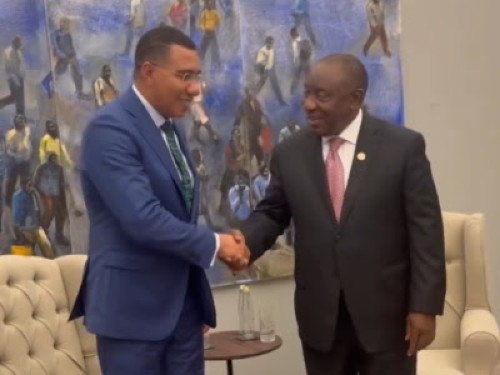 Prime Minister Andrew Holness (lefty) being greeted by South African President, Cyril Ramaphosa, at the G20 summit (Photo courtesy X account of PrimeMInister Holness“having a seat at the table allows us to advocate directly for the issues that shape our region’s future, especially as climate impacts intensify across small island states,” Holness wrote on X.
He extended “since thanks” to South African President Cyril Ramaphosa for the invitation and his country’s leadership during its G20 presidency.
“Throughout the engagements, I met with global leaders to advance conversations on climate financing, resilience and the urgent need for far, accessible support for vulnerable nations,” said Holness, who is also chair of the CARICOM grouping.
In his address to the summit, Holness spoke of the devastation caused to Jamaica by Hurricane Melissa, a category 5 storm that slammed into the country on October 28, killing 42 people and leaving damage estimated at nine billion US dollars.
He said that while the full economic cost will take months to determine, preliminary assessments show “catastrophic losses” for Jamaica, stressing that for Caribbean Small Island Developing States (SIDS), climate change is “an immediate and existential threat.
“Disaster risk reduction is not optional. It is central to our national survival,” Holness said, confirming that Jamaica has activated its disaster-risk financing framework to support immediate relief and recovery efforts but emphasised that the magnitude of destruction exceeds what small economies can manage alone. He expressed gratitude to international partners who have already offered support.
Holness said the unprecedented strength of Hurricane Melissa, following storms such as Hurricane Barry, reinforces the urgency of limiting global warming.
“The world must adhere to the 1.5-degree target,” he said, urging the G20 to scale up climate finance, expand risk-transfer mechanisms, strengthen agricultural resilience, and prioritise investments in climate-proof infrastructure and clean energy systems.
Last weekend’s G20 Leaders’ Summit, the first summit on the African continent was boycotted by the United States, after President Donald Trump falsely accused the South African government of confiscating white-owned land and allowing the killing of white Afrikaners.
Washington had also objected to what it considered the summit’s diversity, equity and inclusion (DEI) agenda.
But as he wrapped up the summit on Sunday, South African Minister of International Relations, Ronald Lamola, remained upbeat saying “in a nutshell … this has been a great success for our country”.
“This gavel of this G20 summit formally closes this summit and now moves on to the next president of the G20, which is the United States, where we shall see each other again next year,” said President Ramaphosa.

