


Jamaica's Government Explores Limited Desalination Projects Amid Water Stress But Rules Out Nationwide Rollout
KINGSTON, Jamaica – Government is conducting feasibility studies on potential desalination projects in St Thomas and Clarendon as it explores ways to augment water supplies in selected water-stressed areas, but has made it clear it is not considering desalination as a nationwide solution because of the high cost and potential environmental impacts.
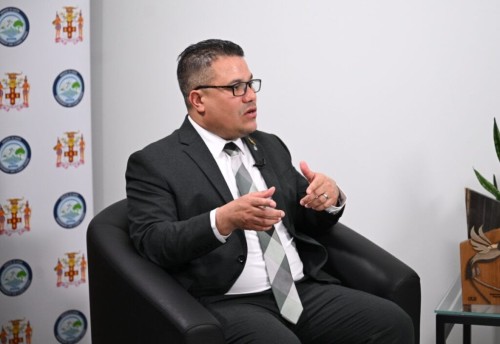 Minister of Water, Environment and Climate Change Matthew Samuda.Minister of Water, Environment and Climate Change Matthew Samuda said the feasibility studies are examining whether desalination could provide additional supplies in selected areas where seawater extraction could be undertaken with limited environmental impact.
Responding to questions during an interview with Jamaica Information Service (JIS) Chief Executive Officer Giovanni Dennis, Samuda said a national desalination programme would have significant implications for consumers.
“Desalination, if it were done at a national level, would significantly change the average tariff that you pay at the household and commercial level for water,” he explained.
Samuda said the Government remains open to using desalination on a limited scale, particularly in areas where it could help address water shortages.
He said the southeastern parish of St Thomas and Clarendon in the south of the island are being assessed as part of an approach that would link desalination with renewable energy generation and storage.
“What needs to be understood in how we have looked at desalination is that desalination will also have to be accompanied by integrated energy projects,” Samuda said.
He explained that the proposed system would use solar-powered infrastructure to extract seawater and pump it to a reservoir for storage. Water released from that reservoir to a lower reservoir would generate energy, helping to offset the cost of desalination.
The desalination process would use reverse osmosis, which removes salt and other dissolved substances from seawater to produce freshwater.
Samuda said the projects are currently at the feasibility study stage, with engineering work expected to begin next year and procurement potentially starting in 2028.
“We’re at the feasibility study phase now, expect to get to engineering next year, and hopefully to the procurement phase by 2028,” he said.

