


Guyana Wants International Community to Follow Its Lead Regarding the Preservation of Forests
ANTALYA, Türkiye – Guyana has told global leaders that the concept of the international community paying countries to keep their forests in tact should be pursued with Vice President Bharrat Jagdeo indicating that the Caribbean Community (CARICOM) country has for nearly 20 years being pushing that initiative.
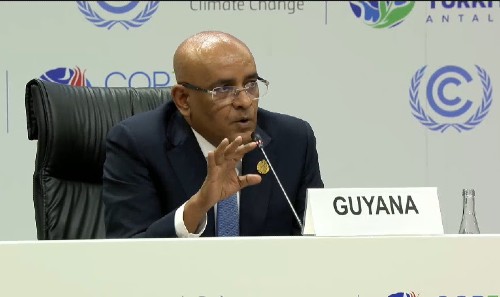 Guyana's Vice President participating in the COP31 Leaders' Summit Event on Forests,Participating with other world leaders at the COP31 Leaders’ Summit Event on Forests, Jagdeo noted that in 2007, when he was head of state in Guyana, he offered to use almost all of the country’s rainforest to help fight climate change, on condition that the world paid to keep the trees standing.
Forests cover 85 per cent of Guyana. And Jagdeo’s then offer led to Guyana’s Low Carbon Development Strategy with Norway being the first big partner, pledging up to US$250 million. In 2022, Guyana became the first country to be issued carbon credits for protecting its forests nationwide.
US oil company Hess, now owned by Chevron, then agreed to buy at least 750millionworthofcreditsover10years.Thisyear,thefundingthatwillcomeinisexpectedtotopUS100 million.
Jagdeo told the event that airlines are now buyers into the initiative with more than 30 airlines buy Guyana’s credits with one-fifth of the money collected going to Indigenous villages, which decide how to spend it.
Jagdeo said the 252 villages had carried out more than 3,000 projects over the past four years and that some of the funding is also used to pay for flood protection and other work to help Guyana adapt to climate change.
Jagdeo said that Guyana still has one of the lowest deforestation rates in the world, at around 0.04 per cent.
“The key to faster progress is finance,” he told the event co-hosted by Guyana along with Brazil, Norway, the Republic of the Congo and the United Kingdom.
According to the “Concept Note” for the “Forests and Climate Action: The Contribution of Forests to Addressing Climate Change” event, forests play a crucial role in implementing the United Nations Framework Convention on Climate Change (UNFCCC) and the Paris Agreement.
“They remove and store carbon at scale, sustain biodiversity and livelihoods, regulate water and climate systems, and provide resilience to communities and economies. Recent trends show encouraging progress: tropical primary rainforest loss declined by 36 per cent in 2025 compared with 2024.”
The leaders were told that sustaining and expanding this progress will require stronger international cooperation and support. Despite this improvement, 4.3 million hectares of tropical primary rainforest were lost in 2025, while fires accounted for 42 per cent of global tree cover loss.
At COP26, the Glasgow Leaders’ Declaration on Forests and Land Use (GLD) set the goal of halting and reversing forest loss and land degradation by 2030, a commitment subsequently reaffirmed in the Global Stocktake.
At COP27, the Forest and Climate Leaders Partnership (FCLP) was founded to continue high level political collaboration on forests. At COP30 in Belém, leaders endorsed the Belém Declaration on the Launch of the Tropical Forest Forever Facility (TFFF) and the Call to Action on Integrated Fire Management and Wildfire Resilience.
The COP30 Presidency also announced the development of a roadmap to halt and reverse deforestation and forest degradation by 2030 and countries also endorsed the COP30 Intergovernmental Land Tenure Commitment.
But despite progress made, the scale of forest loss, alongside escalating heat, drought and fire, makes clear how much further action is needed. The Concept Note adds that COP31 is an opportunity to turn political commitment into implementation at the scale and speed required.
“The Leaders’ event will bring together Heads of State and Government and other leaders to provide further political impetus at COP31 to the 2030 goal to halt and reverse deforestation — not another moment to announce ambition, but an opportunity for Leaders to recognise and expand progress, confront what is still holding delivery back, and reinforce the action and investment needed to reach the goal,” it added.
Jagdeo said that using Guyana’s experiences, he would outline four proposals going forward.
He said firstly, presidents and prime ministers should drive forest protection themselves, not leave it to environment or natural resources ministries.
“You need the leaders to take this up, directly, as President Lula has done,” he said, adding that secondly, rich countries must keep their promises.
Jagdeo said too many governments, “notably in Europe,” had been slow to put into practice the rules of CORSIA, the global scheme that lets airlines offset their emissions.
Jagdeo said forest countries had already spent money meeting those rules.
“We cannot ask forest countries to make long-term commitments while leaving uncertain the international frameworks on which they rely,” he said, noting that thirdly, no country can achieve that goal by itself and that governments need banks, businesses, international bodies and civil society to work with them and to “stay the course.”
Jagdeo said under the fourth proposal, every way of paying for forests should be supported. Jagdeo pointed to six options for funding forest protection set out in a new Forest Finance Roadmap.
They include Brazil’s Tropical Forest Forever Facility, carbon markets like the one Guyana uses, and debt deals.
Jagdeo said countries do not have to choose the same option, but all of them should be made to work, because success in one helps the others.

