


Caribbean Warned of the Existential Crisis Facing Agricultural Sector
BELEM, Brazil – Caribbean agriculture faces an existential crisis as increasingly intense climate events devastate farming communities across the region, experts and development leaders have warned.
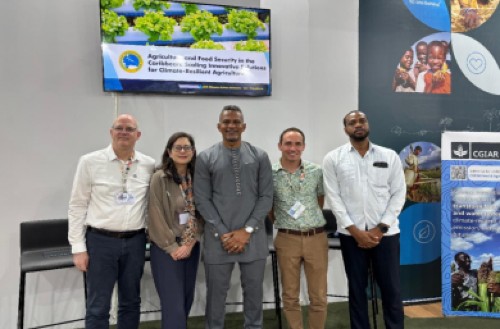 Speaking during the side event at the 30th United Nations Climate Change Conference (COP 30), that ended here last weekend, officials from the Barbados-based Caribbean Development Bank (CDB), the Green Climate Fund (GCF), the Food and Agriculture Organization (FAO) and CGIAR, discussed the top “Agriculture and Food Security in the Caribbean: Scaling Innovative Solutions for Climate-Resilient Agriculture
CDB president, Daniel Best cited the devastating impact of Hurricane Melissa, which recently ravaged Jamaica, noting that the agriculture sector is often among the hardest hit by climate shocks.
“These are not one-off or sporadic events, and these are not hypothetical future scenarios. Our region is suffering right now from increasing temperatures, declining precipitation and rising sea levels, and every year these challenges are being compounded by major storms that are increasingly intense and develop with unprecedented speed. This is a one-two punch that fundamentally threatens our prospects for sustainable development,” he said.
Director of Climate Action at CGIAR, Dr. Todd Rosenstock, noted that extreme events affect not only agricultural production directly but entire value chains and food systems, making it essential to protect both individual farmers’ productive assets and the overall supply chains that sustain Caribbean islands.
However, he also underscored that for the Caribbean, the climate crisis is fundamentally a water crisis.
“It’s the prolonged droughts. It’s the increased rainfall that’s reducing the productive capacity of agricultural land. Really, addressing the water crisis is of the utmost importance,” Rosenstock said.
Director for the Latin America and Caribbean Region at the GCF Secretariat, Kristin Lang, took a similar position.
“We’re all seeing the issue of water security coming into play and we can talk about food, but we can’t have any food if we don’t have any water.” Lang said, adding that “we need to address the issue of irrigation because you are going to see that rainfall is either too much or too little”.
Climate change team leader at FAO, Martial Bernoux, outlined three critical pillars necessary for transformation: policy frameworks, finance mechanisms, and data systems.
However, he delivered a sobering warning on financing, citing the investment gap facing agriculture.
“From the last two reported years, all sectors increased their amount of climate investment by 11 per cent. Agriculture? One per cent. This is the only sector that is not attracting enough investment,” he said, adding that public money alone cannot meet the scale of transformation needed.
“We need trillions. It’s not billions. And to have those trillions, we need to direct investment toward this sector and show that investing in this sector works.”
All the panellists stressed the critical importance of placing farmers, fishers, and rural communities at the centre of climate solutions. The experts also agreed that while challenges are formidable, solutions exist and must be scaled urgently.
The panel discussion was one of several knowledge-sharing and advocacy events CDB hosted or supported at COP 30. The CDB said that its main objective at the global forum was to amplify the deleterious impacts of climate change on the Caribbean’s sustainable development thrust and garner support for effective solutions.
Meanwhile, UN Secretary General, Antonio Guterres, addressing the closing of COP30, said he welcomed the fact that parties have reached an agreement and that “this shows that multilateralism is alive, and that nations can still come together to confront the defining challenges no country can solve alone.
“COP30 has delivered progress – including a call to triple adaptation finance by 2035 as a first step towards closing the adaptation gap; A Just Transition Mechanism to support countries in protecting workers and communities as they shift to clean energy; a new dialogue aimed at enhancing international cooperation on trade;”
Guterres said that there is the recognition that the world is now heading for a temporary overshoot above 1.5 degrees Celsius, despite the launch of a Global Implementation Accelerator to close the ambition and implementation gaps and accelerate the delivery of Nationally Determined Contributions and a recognition to take forward the outcomes of the UAE Consensus, which includes a just, orderly, and equitable transition away from fossil fuels.
“But COPs are consensus-based – and in a period of geopolitical divides, consensus is ever harder to reach. I cannot pretend that COP30 has delivered everything that is needed,” Guterres said, adding “the gap between where we are and what science demands remains dangerously wide.
“I understand many may feel disappointed – especially young people, Indigenous Peoples and those living through climate chaos. The reality of overshoot is a stark warning: we are approaching dangerous and irreversible tipping points.”
He said that staying below 1.5 degrees by the end of the century must remain humanity’s red line, adding “that requires deep, rapid emission cuts – with clear and credible plans to transition away from fossil fuels and towards clean energy.
“It requires climate justice and a massive surge in adaptation and resilience – so communities on the frontlines can survive and recover from the climate disasters to come. And it requires far more climate finance for developing countries to reduce emissions, protect their people, and address loss and damage.
COP30 is over, but our work is not. I will continue pushing for higher ambition and greater solidarity,” Guterres added.

