

WASHINGTON, DC – Trinidad and Tobago’s growth dynamics are expected to remain subdued in 2026 following lower-than-expected growth in 2025, the Inter-American Development Bank (IDB) reported on Tuesday.
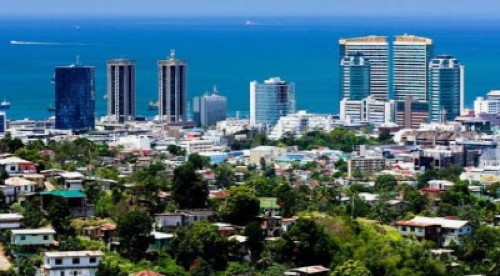 An aerial view of a section of Port of Spain, the Trinidad and Tobago capital.It said real gross domestic product (GDP) growth is estimated at 0.8 per cent for 2025, driven by a 1.2 per cent expansion of the non-energy sector, which buffered the estimated 0.5 per cent decline in the energy sector.
According to the country’s Central Statistical Office, official data for the first three quarters of 2025 show that real GDP expanded by 0.2 per cent, with energy output increasing by 2.2 per cent and non-energy output falling by 0.6 per cent.
The IDB report titled “Fiscal Resilience, Debt Reduction and Domestic Resources Mobilization in the Caribbean,” noted that fiscal performance remains subject to volatile global energy prices, and the interest burden has been rising.
It said that the revision of budgeted oil and gas prices in financial year2024/2025 resulted in a downward adjustment to originally estimated government revenues accompanied by higher-than-initially-budgeted expenditure and therefore a wider projected fiscal deficit.
“Even so, at the end of the fiscal year in September 2025, with weighted average gas prices surging above mid-budget estimates, the final deficit outcome was 16 per cent below the mid-budget projections, reaching TT$8.1 billion or about five per cent of GDP.
“Notably, the widening gap between the primary and overall surplus indicates an increasing interest burden, as public sector debt has been rising. The primary balance is expected to reach a surplus of 1.3 per cent of GDP in financial year2026/2027 and two per cent of GDP in financial year 2027/2028. In contrast, the overall balance will be in deficit, averaging 2.7 per cent of GDP for 2026–2031,” the IDB said.
It said that public sector debt has been increasing consistently over the past decade. The debt-to-GDP ratio reached 84 per cent in financial year 2024/2025 and is expected to remain elevated in the medium term, hovering between 81 and 84 per cent from 2026 to 2031.
“Despite this elevated debt level, short-term external debt buffers remained sufficient, given that the external-debt-to-GDP ratio was 21 per cent of GDP in financial year 2024/2025 but the Heritage and Stabilization Fund (HSF) was valued at around 25 per cent of GDP and net official reserves stood at 21 per cent of GDP.”
The IDB said that although this level is above international adequacy benchmarks at approximately six months of import cover, reserves have been declining due to lower energy sector output and, by extension, lower foreign exchange earnings.
According to the report, increased energy prices have created an opportunity to rebuild fiscal buffers through both the HSF and energy revenues. If actual energy prices rise above the budgeted price, the rules that govern the HSF require the government to deposit 60 per cent of excess revenue into the fund, as happened in 2022 and 2023 when a total of US$346 million was deposited, the first deposits since 2013.
It said energy revenues respond similarly. in 2022, energy revenues increased by 179 per cent year-over-year and remained above average in 2023 before normalizing. In turn, the fiscal balance in fiscal year 2022 benefited from a surplus following more than a decade of deficits.
“Accordingly, if energy prices remain elevated under current conditions, there might be fiscal gains by the end of financial year 2025/2026. Nonetheless, long-term savings have been performing moderately despite withdrawals between 2023 and 2025.
The IDB is predicting that higher energy prices will strengthen external balances.
It said Trinidad and Tobago’s energy exports have accounted for around 81 per cent of total commodity exports over the past decade, while net energy exports – net of imported fuels – have accounted for an average of 41 per cent of total commodity trade.
Natural gas is the main component of energy exports both in liquefied form and as an input for the production of petrochemicals such as ammonia, methanol, and urea. Given the conflict in the Middle East, upward pressure on natural gas prices may continue, which can tilt the balance for Trinidad and Tobago to the upside by strengthening the country’s terms of trade.
The IDB said that this upswing in exports could also contribute to improving the external reserve position of the economy.
“These gains, however, are partly offset by higher energy prices working in the opposite direction. Higher international energy prices translate into increases in the general price level for imports, especially food prices, as observed in 2022–2023 when headline inflation increased moderately while food inflation was very volatile, although relatively contained compared to earlier years.”
Government subsidies for fuel and electricity contribute to this relatively low inflation rate. On the fiscal side, the full potential of this windfall is smaller if more expenditure is used to subsidize imported fuel. Between 2022 and 2025, spending on fuel subsidies averaged two per cent of government revenue, although it fell from three per cent in 2023 to one per cent in 2025, according to the Ministry of Finance.
However, the spending is buffered by the vast fuel storage capacity of the state-owned fuel trading company, which provides some protection from extreme price volatility.
Higher windfall savings could have been realized if more natural gas had been exported instead of consumed domestically.
With natural gas supplying almost 100 per cent of electricity generation, every unit burned domestically at subsidized rates presents an opportunity cost for potential gains of these global price surges. Proper management of the expected windfall is crucial for economic sustainability, as price shocks historically tend to have a long-lasting effect on government expenditure through procyclical tendencies.
Going forward, the IDB report said that the energy sector is expected to rebound in the medium term.
“This assumes increased gas production following sustained production declines since 2014. Several natural gas projects including the Loran-Manatee and Dragon Gas projects are carded to begin production in 2027 and 2028, subject to required approvals and investments.
“The increased natural gas resources are expected to temporarily boost growth above the Latin American and Caribbean average to three per cent and 3.5 per cent in 2027 and 2028, respectively, then average 2.2 per cent over 2029–2031.”
Short-term external buffers remain relatively strong as a result of foreign reserves and HSF savings, but long-term stability depends on astute management of resources. Sustained economic resilience will depend on prudent fiscal management, effective use of energy windfalls, and continued expansion of the non-energy sector to reduce dependence on volatile hydrocarbon revenues.
The IDB said that over the medium term, strengthening non-energy sector growth remains critical to achieve more resilient, inclusive, and sustainable economic growth.
“However, structural constraints continue to hinder diversification efforts, including continued challenges accessing foreign exchange, along with citizen insecurity, both of which limit competitiveness and the expansion of non-energy activities.” it added.

